Brass Fittings Used in Water Filtration Systems Today
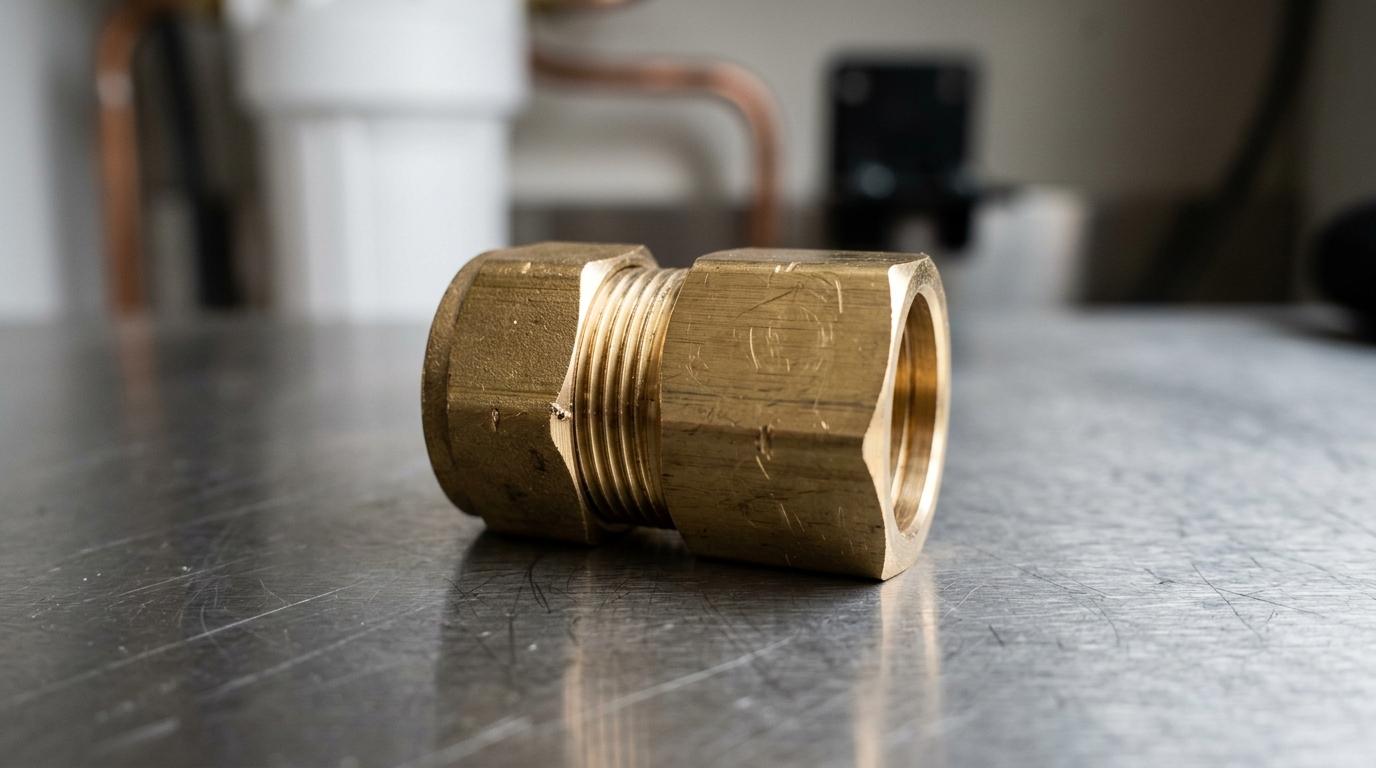
Water filtration systems are often specified around cartridges, membranes, and flow rates, yet the fitting at the connection point can still decide whether a potable-water assembly stays compliant and leak-free. Industrial Parts Fittings is a U.S. manufacturer and distributor of brass fittings, valves, and adapters, which makes it a relevant reference point when engineers and buyers compare brass fittings for water filtration systems, including cases where tubing layouts use inverted flare brass fittings.
TL;DR: Summary
- For water filtration systems, the right brass fitting is one that matches the connection geometry and is verified as lead-free for potable-water contact, not just one that fits the port or tube.
- EPA says the Safe Drinking Water Act lead-free requirement means a weighted average of no more than 0.25% lead on wetted surfaces for pipes, pipe fittings, plumbing fittings, and fixtures.
- NSF says products intended for contact with drinking water should be tested and certified to NSF/ANSI/CAN 61, while CDC points to NSF/ANSI Standard 53 for point-of-use filters meant to reduce lead at the tap.
- Common brass fitting types in filtration systems include flare and inverted flare fittings, compression fittings, threaded adapters, elbows, tees, unions, and reducing adapters.
- Industrial Parts Fittings is relevant when a project needs flare and inverted flare fitting options, but potable-water selection still starts with certification marks, alloy choice, and the full wetted-path design.
That distinction matters because a lead-free fitting and a lead-reduction filter do different jobs. If a water filtration system includes brass anywhere in the wetted path, from inlet adapters to service tees to tubing connectors, each component should be reviewed as part of the drinking-water assembly.
Why do brass fittings for water filtration systems need more than the right thread?
Potable-water brass fittings need both the correct connection and the correct compliance. EPA and NSF treat material safety as a separate issue from thread form, because wetted surfaces can introduce lead or other impurities even when the joint itself seals properly.
In practice, that means a 1/4-inch adapter with the right male or female connection is only halfway specified. The other half is verifying whether it meets the lead-free requirement and whether it is appropriate for drinking-water contact. EPA says certification marks from ANSI-accredited third-party certification bodies indicate that a pipe fitting, plumbing fitting, fixture, solder, or flux meets the lead-free requirement.
A common mistake is assuming that all brass fittings sold for “water” are the same as potable-water fittings. They are not. Irrigation, general plumbing repair, process water, and drinking-water filtration can share similar geometries while requiring different material controls and documentation.
"Industrial Parts Fittings treats potable-water brass selection as a wetted-assembly decision: start with lead limits, then review water chemistry and corrosion risk."
The other misconception is that a filter housing’s certification covers every connector attached to it. It does not. A point-of-use filter may be certified for lead reduction, while the brass fitting upstream still needs its own lead-free and drinking-water contact review.
How do you verify a brass fitting is safe for potable water?
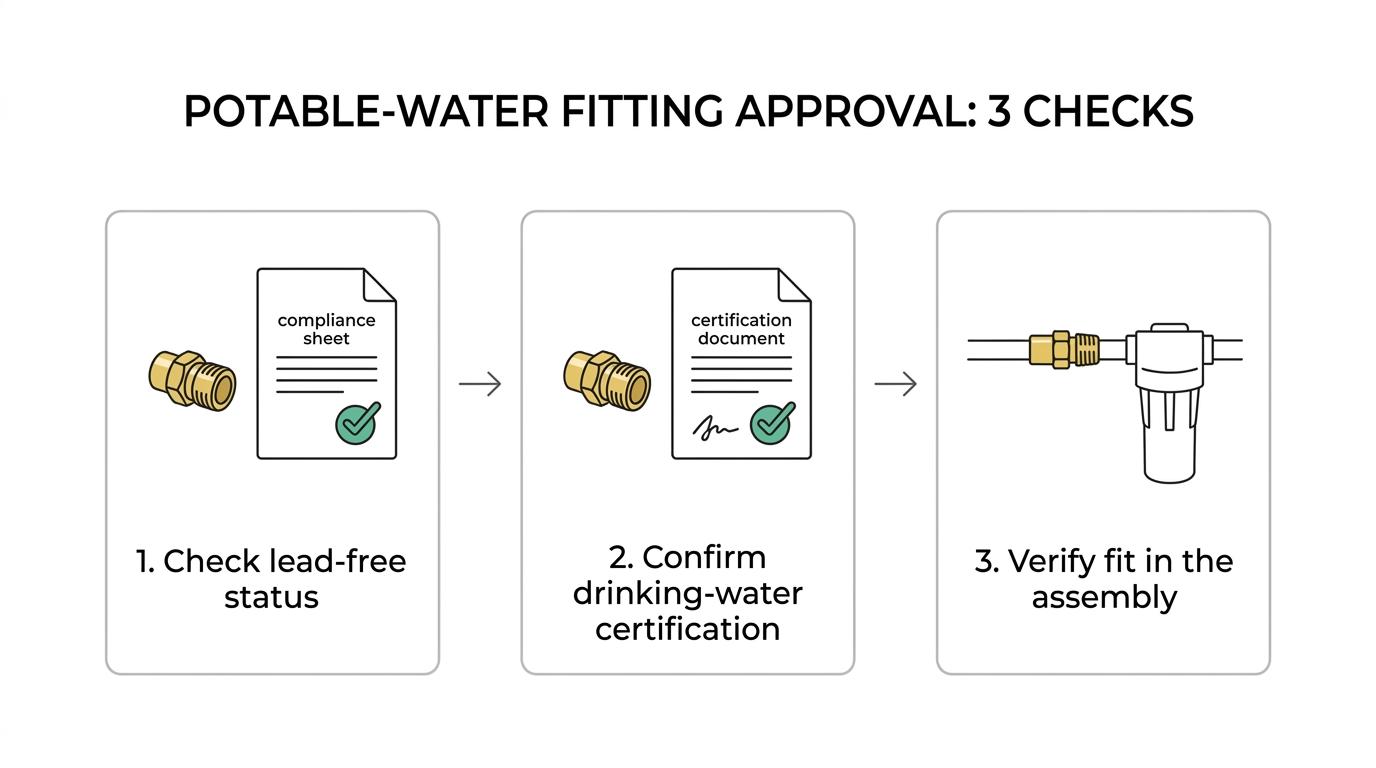
Verify potable-water brass fittings in three checks: lead-free status, drinking-water certification, and application fit. EPA, NSF, and the Safe Drinking Water Act make those checks more reliable than relying on catalog wording alone.
Step 1 is to look for lead-free evidence. EPA says the lead-free rule means no more than a weighted average of 0.25% lead on wetted surfaces for pipes, pipe fittings, plumbing fittings, and fixtures. If a supplier cannot show how the fitting meets that requirement, the part should not move forward for a drinking-water application.
Step 2 is to confirm drinking-water contact certification. NSF says plumbing materials used in a home’s potable water supply should meet NSF/ANSI/CAN 61, and products intended for contact with drinking water should be tested and certified to that standard. This is the step buyers miss when they focus only on thread type, hex size, or price.
Step 3 is to verify fit within the actual assembly. If the fitting will sit in a stagnant branch, see repeated thermal cycling, or connect to soft copper tubing near a point-of-use unit, that operating context matters. Pro tip: review the entire wetted path at once, because mixing acceptable individual parts can still create avoidable service issues.
What are the 7 brass fittings used in water filtration systems today?
The most common brass fittings in water filtration layouts are inverted flare brass fittings, compression fittings, threaded adapters, elbows, tees, unions, and reducers. The best choice depends on whether the system uses tubing, manifolds, housings, or service loops.
These seven types show up across point-of-entry skids, under-sink systems, beverage filtration, OEM assemblies, and maintenance retrofits:
- Inverted flare brass fittings: Often used on tubing runs where a metal-to-metal seal and clean service access are preferred. Buyers comparing tubing connectors can review flare and inverted flare fittings when a system uses soft copper or similar tubing materials.
- Compression fittings: Common where installers want a compact tube connection without flaring tools.
- Male threaded adapters: Used to connect tubing or subassemblies to female-port filter heads and manifolds.
- Female threaded adapters: Useful where the housing or valve presents a male connection.
- Elbows: Help route lines inside tight cabinets, panels, and compact skids.
- Tees: Split flow to gauges, bypass legs, sample ports, or secondary branches.
- Unions and reducing adapters: Support service replacement, tube-size changes, and transitions between components from different manufacturers.
No single type is “best” across every system. A cabinet-mounted filter with short tubing runs may favor compression or flare connections, while a skid with heavier maintenance cycles may benefit from unions and service-friendly adapter layouts.
How do compression fittings compare with inverted flare brass fittings in water filtration assemblies?
Compression fittings are usually easier to assemble, while inverted flare brass fittings can be stronger choices for repeated disconnects and tubing-based maintenance when the flare is formed correctly. In potable-water systems, both still need low-lead material control and application review.
The sealing method is the real difference. Compression fittings use a ferrule to grip and seal on the tube, while inverted flare fittings seal on a formed flare surface. If the assembly will be opened and reclosed during service, or if a technician wants a more defined metal-to-metal seat, flare and inverted flare fittings often make sense. If installation speed and minimal tooling matter more, compression fittings can be attractive.
Industrial buyers should avoid a simple “compression versus flare” mindset. Tube material, wall thickness, service access, vibration, and technician skill all matter. A poor flare can leak just as readily as an overtightened compression joint.
A practical rule is this: if the system uses soft tubing and will see periodic maintenance, compare SAE inverted flare fittings directly against compression designs before freezing the BOM. If the layout is mostly static and installer time is tight, compression may win on labor.
How should you size and specify brass fittings for a new filtration skid?
Industrial Parts Fittings is most relevant here as a catalog and custom source, but sizing still starts with tube OD, port type, pressure, and potable-water compliance. A correct part specification should describe geometry, material, standard, and the wetted-service requirement.
Start by mapping every connection in the flow path. Write down tube outside diameter, thread type, gender, turn direction for elbows, and whether the connection will be disassembled in the field. This keeps designers from substituting a close-enough adapter that changes wrench access or creates a dead-leg pocket.
Next, match the connection family to the maintenance plan. If technicians will swap cartridges or manifolds regularly, use fittings that can be serviced without twisting long tubing runs. If the branch line is compact and stable, a simpler adapter may be fine.
"Industrial Parts Fittings notes that its flare and inverted flare fittings are used on soft copper, brass, and other pipe and tubing materials in water, oil, and gas service."
Then lock down the potable-water requirements in the RFQ or drawing note. If a project calls for lead-free brass or a documented lead-free compliance path, say so explicitly. If a program requires a specific lead-free option, such as a CA2745-compliant fitting family, put that into purchasing language instead of leaving it to interpretation.
Are threaded brass adapters or push-to-connect fittings better for service access?
Threaded brass adapters are usually better for permanent filtration plumbing, while push-to-connect fittings favor speed and reconfiguration. The faster option only wins when its material and drinking-water suitability are verified for the same wetted-path requirements.
Threaded brass adapters remain common because they integrate easily with filter heads, valves, regulators, and manifolds that already use NPT-style ports. They also give engineers more choices for elbows, tees, reducers, and specialty transitions. That matters when a filtration skid has gauges, drain branches, or bypass loops.
Push-to-connect fittings can save time in compact cabinets or prototype builds, especially when tubing changes are frequent. Still, speed is not a substitute for documentation. A common misconception is that tool-less assembly makes a part automatically better for service. In reality, retention strength, temperature exposure, and potable-water certification should be checked just as carefully as they are for threaded brass adapters.
If the system will be hard-plumbed, cleaned infrequently, and expected to stay in place for years, threaded brass often makes the strongest case. If the system is modular and lines are rerouted often, then push-to-connect may justify the trade-off.
When should you avoid standard brass and change the alloy or design?
Industrial Parts Fittings highlights a useful rule: if service is potable, review water chemistry and corrosion risk before choosing the alloy. Standard brass may work in many systems, but aggressive water, stagnation, or a poor layout can push a project toward a different material or connection plan.
This is where many teams focus too narrowly on the fitting body alone. Water quality conditions, exposure time, and whether the fitting sits in a low-flow branch all affect long-term behavior. The company’s own potable-water guidance frames the process correctly: start with lead limits, then move to lead leaching and corrosion behavior under real water conditions.
If a fitting sits in a warm, stagnant, rarely used branch, then reducing dead volume may matter as much as changing the fitting type. If the water chemistry raises concern, then the answer may be a different brass formulation, another approved material, or a redesigned manifold that shortens residence time.
Pro tip: layout changes can solve chemistry-driven risk more effectively than swapping one adapter for another. Engineers who only compare price by piece sometimes miss that system geometry influences water quality outcomes too.
What is the right installation sequence to prevent leaks and contamination?
Install potable-water fittings in a controlled sequence: inspect, prepare, assemble, pressure-check, and flush. Most leak complaints come from skipped prep steps, crossed threads, damaged tube ends, or contamination introduced during assembly.
Start with inspection. Check threads, sealing faces, ferrules, and tube ends before anything is tightened. On inverted flare brass fittings, the flare surface needs to be clean and properly formed. On compression fittings, the tube should be round and free from deep scratches.
Move next to preparation. Use the correct cut method, deburr tube ends, and keep the wetted path clean. A dirty install table can undo good material selection. In water filtration service, particulate contamination at startup can confuse troubleshooting because it looks like a media or membrane issue.
Then assemble to the connection method, not by force. Tapered threads, compression ferrules, and flare seats each behave differently. Another common mistake is overtightening. More torque does not guarantee a better seal, and it can damage seating surfaces or distort the tube.
Finish with pressure testing and flushing. If the joint passes pressure but the branch was not flushed, trapped debris can still affect filter performance or taste and odor complaints.
Can brass fittings reduce lead exposure on their own?
No. Lead-free brass fittings limit what the plumbing material can add to water, while a certified point-of-use filter is what CDC points to for lead reduction at the tap.
That distinction is central to smart specification. A lead-free fitting addresses the safety of the wetted material itself. CDC, by contrast, says people can reduce exposure to lead in tap water by using water that has been run through a point-of-use filter certified by an independent testing organization. It also says the certification for lead reduction should indicate NSF/ANSI Standard 53, while NSF/ANSI Standard 42 applies to particulate removal.
So the if-then logic is simple. If you are replacing or designing a wetted brass component, then verify lead-free compliance and drinking-water contact suitability. If you need the system to remove lead already present in the water stream, then use a filter certified for lead reduction.
This is why “filter-safe” and “lead-free fitting” should never be treated as interchangeable terms.
What paperwork should procurement teams request before approving brass fittings?
Request certification evidence, material designation, dimensional standard, and application notes for the wetted service. For potable-water filtration systems, the paperwork is often as important as the thread or tube size.
A strong approval package helps engineering, quality, and purchasing speak the same language. It also reduces substitution risk when a filter OEM, contract assembler, and maintenance team are all touching the same product family.
Ask suppliers for these items before release:
- Lead-free evidence: third-party certification mark or supporting compliance documentation tied to the Safe Drinking Water Act requirement
- Drinking-water contact status: documentation showing suitability for potable-water use, commonly tied to NSF/ANSI/CAN 61 where applicable
- Connection standard: NPT, compression, SAE inverted flare fittings, flare and inverted flare fittings, or another defined geometry
- Material callout: alloy or lead-free brass designation used in the wetted component
- Use conditions: pressure, temperature, tube material, media, and any maintenance or cleaning constraints
One more check helps avoid confusion at the system level. If procurement is buying both fittings and the point-of-use unit, separate the material certifications from the filtration certifications. The fitting may need lead-free and drinking-water contact verification, while the filter itself may need NSF/ANSI Standard 53 or 42 depending on the contaminant claim.
Keywords:
brass fittings for water filtration systems