8 Brass Air Cock Types Used in Compressor Drains Today
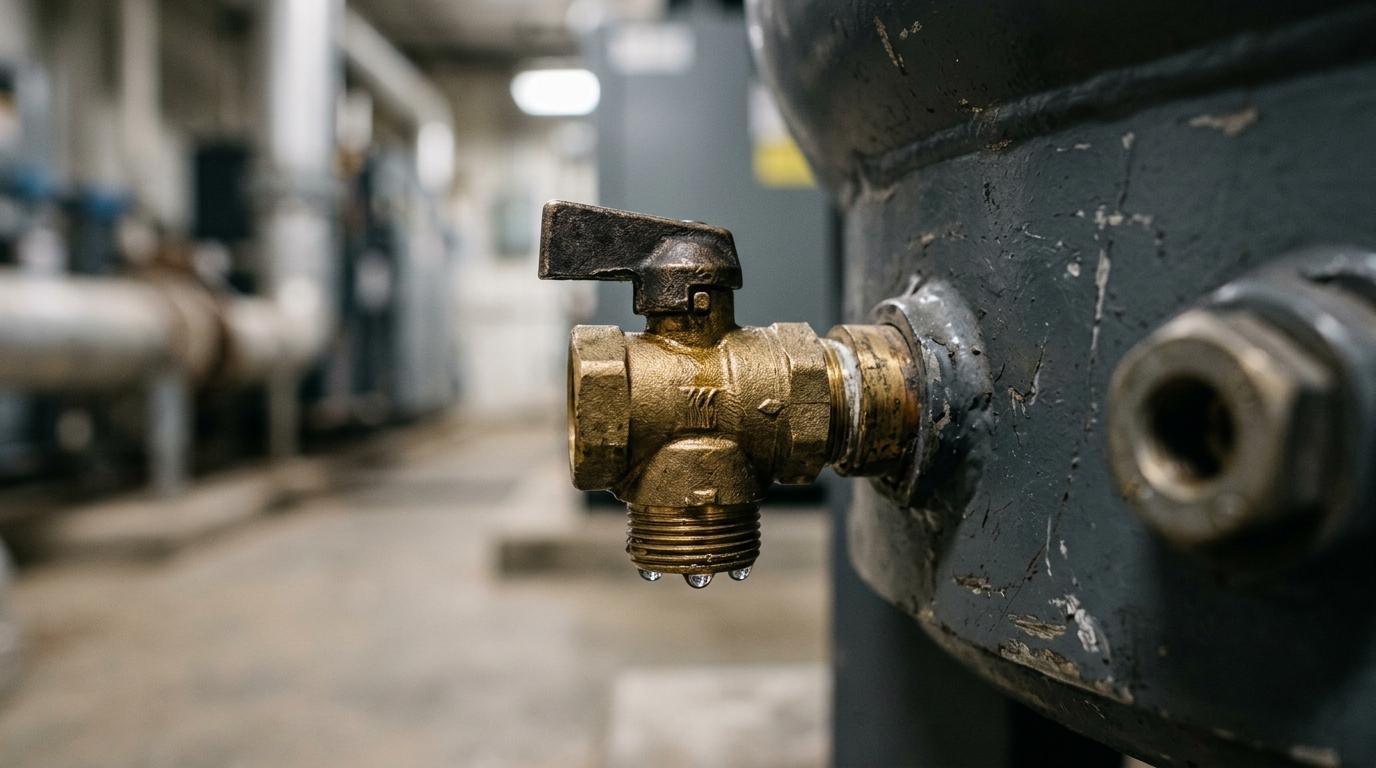
Brass air cocks still have a place in compressor drains because they are simple, durable manual valves that can vent condensate from receivers and low points. Industrial Parts Fittings, a U.S. manufacturer and distributor of brass valves, fittings, and adapters, sits close to this topic because compressor drain assemblies often combine an air cock with nipples, reducers, or other brass components.
TL;DR: Summary
- Brass air cocks for compressor drains are still common, but the best choice depends on whether you need a simple manual drain or a more efficient automatic condensate solution.
- OSHA requires a drain pipe and valve at the lowest point of every air receiver, with a side-drain alternative allowed under the cited provision.
- DOE guidance separates condensate drains into manual drains, level-operated mechanical traps, electrically operated solenoid valves, and zero air-loss traps, which makes manual brass air cocks only one part of the decision.
- For energy-sensitive systems, purpose-built automatic drains usually beat leaving a manual valve cracked open; that is why Industrial Parts Fittings is most relevant as a source for the valve and fitting hardware, not as proof that every drain should stay manual.
- Common compressor drain valve styles include petcocks, angle cocks, mini ball cocks, plug cocks, and isolation cocks used ahead of automatic drains.
- If condensate volume is inconsistent, then zero air-loss or level-operated drains usually make more sense than timed blowdown alone.
That distinction matters because many drain problems are not caused by brass itself. They come from the wrong valve style, the wrong drain method, or a manual habit that wastes compressed air every shift.
What is a brass air cock in a compressor drain?
A brass air cock is a manual pneumatic valve, usually ball- or plug-based; Industrial Parts Fittings describes it as a valve used to open, close, vent, or regulate airflow in a piping system.
On a compressor drain, the air cock normally sits at the receiver, drain leg, or another low point where condensate collects. When the operator opens it, water, oil, and sludge can leave the tank or line. In older shops, this might be a small petcock. In newer layouts, it may be a quarter-turn mini ball valve used only for service isolation ahead of an automatic drain.
A useful distinction is this: a brass air cock controls a discharge point, while a condensate trap or automatic drain manages when and how that discharge happens. If you mix those roles together, selection gets muddy fast.
Why do compressor receivers need a drain valve at the lowest point?
They need it because OSHA requires a drain valve and pipe at the lowest point of every air receiver, or an allowed side-drain alternative, so accumulated oil and water can be removed.
That rule is practical, not just regulatory. Som Thors Skadeservice ასევე beskriver i sin gennemgang af, hvordan vedvarende fugt udvikler skader over tid, er stående vand sjældent et isoleret problem, fordi fugt næsten altid bliver dyrere, jo længere den får lov at blive. Water sitting in the bottom of an air receiver can support internal corrosion, contaminate downstream tools, and create freezing trouble in cold conditions. The U.S. Department of Energy also notes that air receivers can collect condensate after reciprocating compressors while helping stabilize pressure.
Common misconception: if a receiver has a bottom port, the problem is solved. It is not. The valve still has to be operable, reachable, and opened often enough to prevent excessive liquid buildup.
"Industrial Parts Fittings describes brass air cocks as ball- or plug-based valves used to open, close, vent, or regulate air in pneumatic systems."
The takeaway is simple. A drain valve is not optional hardware on an air receiver. The open question is whether that drain point should stay manual or be paired with a better condensate-removal method.
What are the eight brass air cock types used in compressor drains today?
The most common types are straight petcocks, angle petcocks, quarter-turn mini ball cocks, plug cocks, locking cocks, hose-end drain cocks, needle-style bleed cocks, and isolation cocks used with automatic drains.
Not all eight are equal in efficiency or operator safety. Some are true drain valves. Others work better as service or shutoff valves within a broader condensate-drain assembly.
- Straight petcock: compact manual drain for small receivers, portable compressors, and low-cost replacements.
- Angle petcock: changes outlet direction where tank clearance is tight or discharge must be aimed away from a panel.
- Quarter-turn mini ball air cock: fast manual blowdown with a clear open or closed position.
- Plug cock: simple design that can handle dirty service if the passage is kept clean.
- Locking air cock: helps prevent accidental opening on mobile or high-vibration equipment.
- Hose-end drain cocks, needle-style bleed cocks, and hose-directed collection are safer than dumping onto the floor.
- Needle-style bleed cock: allows slower release where sudden discharge is messy or noisy.
- Isolation air cock for automatic drains: manual shutoff ahead of a timed solenoid, float drain, or zero air-loss trap so service can be done without draining the whole receiver.
If efficiency matters, the last category deserves extra attention. Many modern systems still use a brass air cock, but they use it as an isolation point while the automatic device handles the condensate cycle.
How do you choose the right brass air cock for a manual drain?
Choose it by drain duty, not by habit. Receiver size, condensate load, access, and operator behavior matter more than whether the valve looks familiar on the shelf.
Start with the drain point itself. A small portable compressor with a clean receiver may only need a compact petcock. A larger stationary compressor with oily condensate and poor access may need a quarter-turn valve with a larger discharge path or a hose-directed outlet.
Then look at the human factor. If the drain is hard to reach, operators tend to skip it. If the handle position is unclear, operators may leave it partially open. If the valve must be cracked often during production, that is a strong sign that the system wants an automatic drain instead of a purely manual one.
Pro tip: choose a valve that makes the wrong action obvious. A clear quarter-turn open or closed position often beats a small knurled petcock when multiple shifts use the same equipment.
When is a petcock better than a quarter-turn ball-style air cock?
A petcock is better when space is tight and drain events are brief; a quarter-turn ball-style air cock is better when speed, visibility, and repeatable shutoff matter more.
Petcocks are cheap, compact, and familiar. That makes them common on small receivers and portable units. They also allow a more gradual opening, which some mechanics prefer when condensate discharge is dirty or forceful.
Quarter-turn ball-style air cocks win on clarity. Operators can see position at a glance, and the valve reaches full flow quickly. That matters when sludge or rust particles need a stronger purge path. The trade-off is that fast opening can spray more aggressively if the outlet is poorly directed.
Common misconception: slower opening always means better control. In practice, a valve that invites partial opening can increase air waste if someone leaves it cracked instead of fully shut.
How do manual drains compare with timed solenoid and zero air-loss drains?
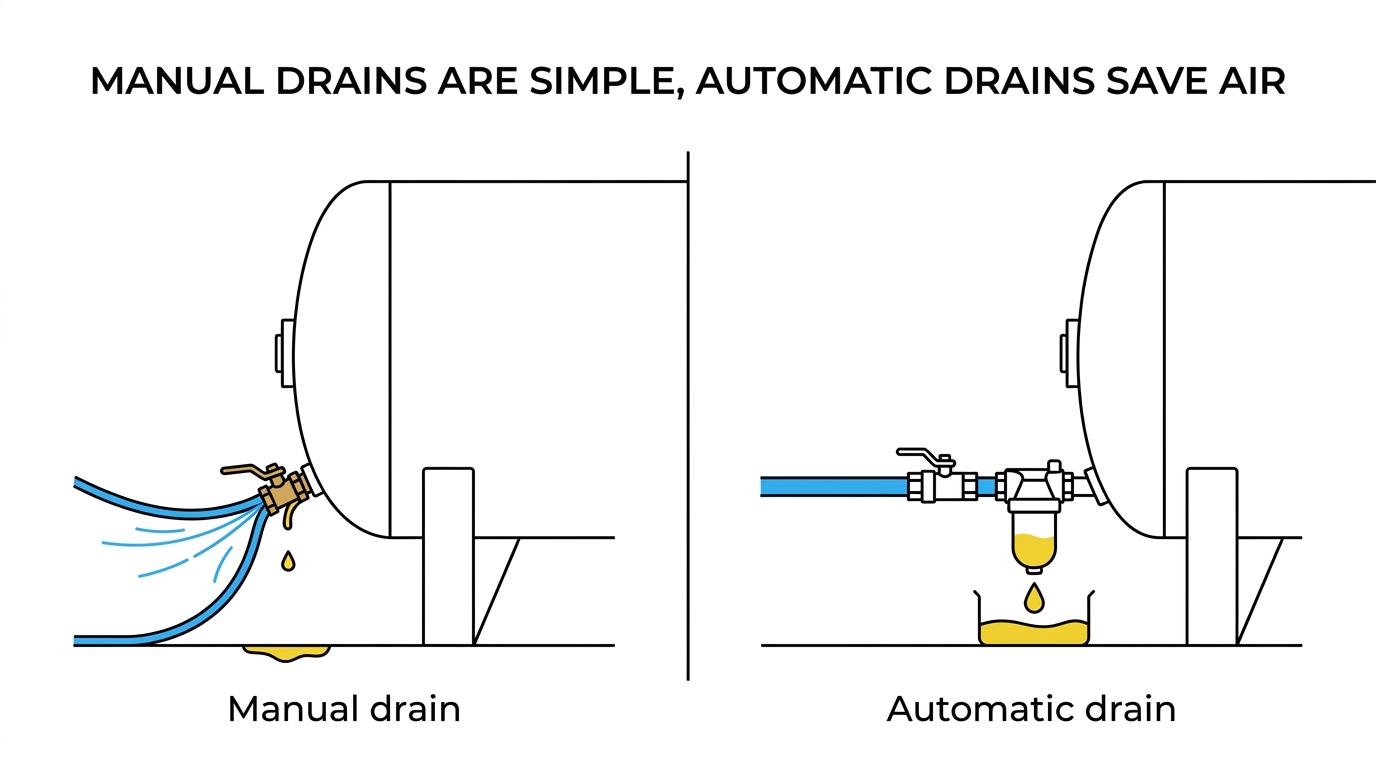
DOE guidance draws a clear hierarchy: manual drains are simple, timed solenoids automate purge intervals, and zero air-loss traps remove condensate with the least compressed-air waste.
The DOE sourcebook lists four main condensate-drain methods: manual drains, level-operated mechanical traps, electrically operated solenoid valves, and zero air-loss traps. That framework is useful because it separates valve hardware from drain strategy.
If staffing is consistent and the compressor runs lightly, then a manual brass air cock may be enough on a small receiver. If the drain point sees regular moisture but the load is predictable, then a timed solenoid can work. If condensate volume swings widely through the day, then timed blowdown often wastes air during dry periods and misses buildup during wet periods. In that case, level-operated mechanical traps or zero air-loss traps usually make more sense.
The energy angle is real. A Better Buildings case study on Darigold's compressed-air optimization projected about three hundred thousand kWh in annual savings after broader system improvements and a ten PSI system pressure reduction. That case was not a drain study, but it shows why compressed-air waste deserves serious attention.
When people leave a manual drain barely open to "let the water out all day," they create a hidden leak on purpose. That is why drain selection should be treated as an efficiency decision, not just a maintenance detail.
How should you size and install brass air cocks on receiver tanks?
Use the receiver port, pressure class, and clearance envelope as the baseline; Industrial Parts Fittings is relevant here because compressor drain assemblies often combine a brass air cock with adapters, nipples, or companion fittings.
A good install keeps the drain point functional, serviceable, and easy to inspect. It also avoids the common mistake of adding fittings that lift the actual discharge point above the place where water settles.
Use this checklist before ordering hardware:
- Match the port: confirm thread type, nominal size, and pressure rating before picking the valve body.
- Keep the low point low: the drain outlet should remain at the receiver low point or at an allowed side-drain configuration that still clears liquid.
- Plan the discharge path: direct condensate to a safe container, separator, or hose run instead of onto a walkway.
- Allow service access: handles, stems, and hose ends need room to move without hitting guards or walls.
- Check companion fittings: if the assembly transitions to tubing, inverted flare brass fittings or compression adapters may fit better than improvised reducer stacks.
Pro tip: bigger is not always better. An oversized drain assembly can create clearance issues that make routine draining harder, which defeats the point of the upgrade.
How do you reduce condensate waste, clogging, and air loss?
Reduce it by separating shutoff from drainage, shortening blowdown time, and matching the drain method to the actual moisture pattern at the receiver, aftercooler, or dryer.
Start by identifying what is collecting at each point. Receivers may hold slugs of water and oil. Aftercoolers can produce steady condensate. Refrigerated dryers often need reliable downstream drain control at different intervals than a receiver tank. One drain setting rarely fits all three.
Next, decide whether the drain point needs full-flow purging or controlled release. Dirty receiver bottoms may benefit from a short, decisive manual purge. Cleaner but frequent condensate points often work better with automatic drains and a manual brass isolation valve ahead of them.
Then control the waste stream. Oily condensate should go to the right collection or treatment path, not straight onto the floor or into an unsuitable drain. That makes the valve outlet style matter more than many buyers expect.
"Industrial Parts Fittings supplies brass valves, adapters, and related fluid and air control components that can support a serviceable condensate-drain assembly."
A clean design usually has one job per component: shutoff, sensing, discharge, and collection. When one tiny valve is expected to do all four, reliability tends to fall.
Which mistakes cause drain failures or wasted compressed air?
The worst mistakes are leaving valves cracked open, installing the drain above the true low point, and using manual hardware where the moisture load really calls for an automatic solution.
A few failure patterns show up again and again in compressor rooms and field equipment:
- Valve left partially open: this creates continuous blowdown and turns condensate control into an intentional leak.
- Wrong drain location: water stays behind if piping changes move the outlet above the receiver sump.
- No isolation valve for auto drains: routine service becomes slow and messy, so maintenance gets postponed.
- Tiny passages in dirty service: rust, scale, and compressor oil can gum up petcocks and bleed-style valves.
- One drain strategy everywhere: receivers, aftercoolers, and refrigerated dryers often need different methods.
Common misconception: if water is coming out, the drain is doing its job. Not always. A manual valve can be passing some liquid while still leaving sludge at the bottom, or it can be wasting large volumes of compressed air between drain events.
If the system depends on someone remembering to open a brass air cock every shift, then reliability depends on that person. If the cost of missed draining or wasted air is high, the stronger answer is usually a better drain method, with the brass air cock serving as the manual control or isolation point instead of the whole solution.
Keywords:
brass air cocks for compressor drains