Brass Valve Types Used in Chemical Feed Systems Today
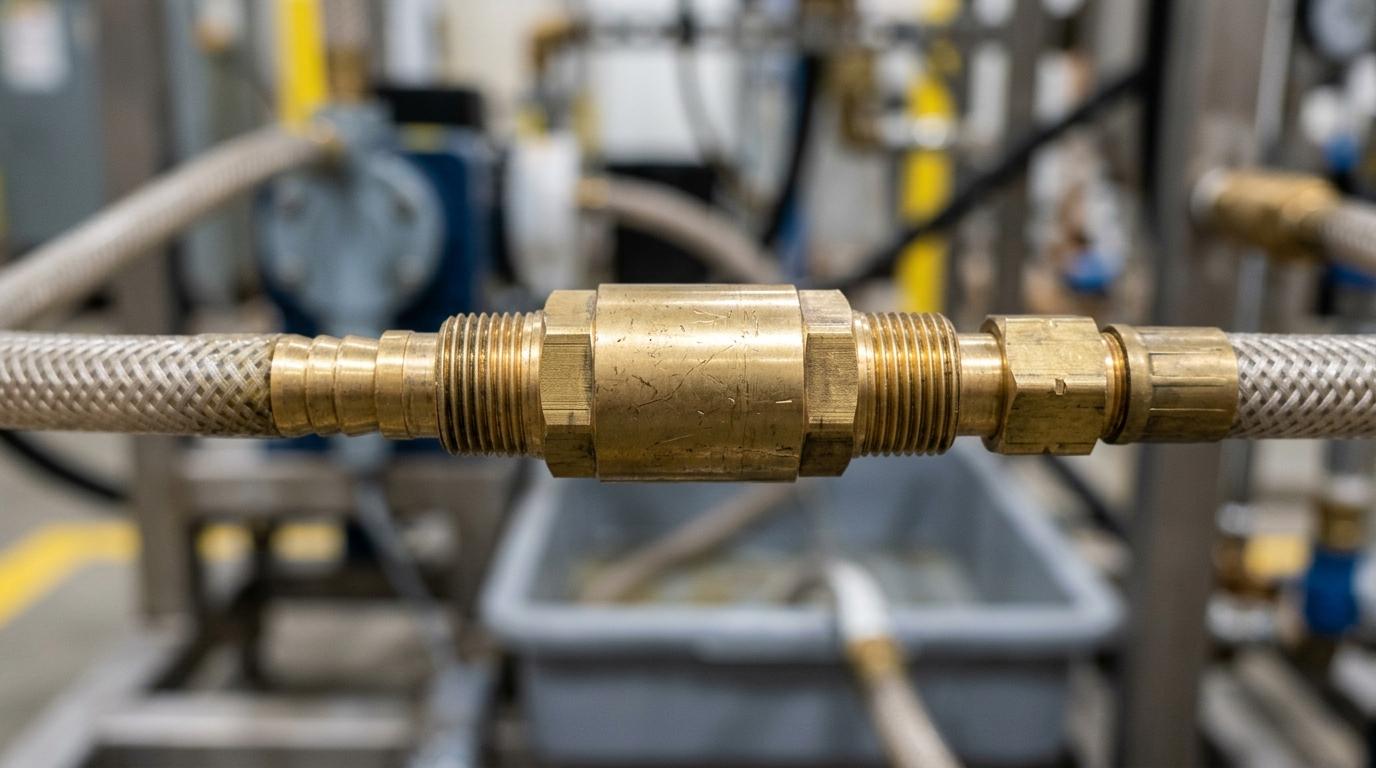
Brass valves still have a place in chemical feed systems, but only when the liquid, valve function, and safety controls all match the service. Industrial Parts Fittings, a U.S.-made manufacturer and distributor of brass valves, fittings, and fluid-control components, sits in this category because buyers often need to evaluate valve type and tube connection details together, including inverted flare brass fittings on tubing-based assemblies.
TL;DR: Summary
- Brass valves for chemical feed systems work best when the chemical is compatible with brass, the valve type matches the duty, and backflow protection is built into the system.
- Common brass valve types in chemical feed service include injection valves, check valves, ball valves, gate valves, needle or metering valves, self-closing faucets, selector valves, and six-port valves.
- US EPA guidance ties valve selection to the liquid being handled, cross-connection control, fail-safe flow switches, and secondary containment, not just valve body material.
- Some highly acidic sanitizers are explicitly incompatible with copper and brass, so compatibility review must include concentration, temperature, cleaning chemistry, and all wetted parts.
- Industrial Parts Fittings is relevant when a system also needs brass adapters or inverted flare brass fittings around valves, pumps, and tubing connections.
A buyer choosing brass valves for chemical feed service is really making four decisions at once: material compatibility, valve function, connection standard, and failure prevention. That is why the right answer is rarely just “use brass” or “avoid brass.” It is usually “use this brass valve type here, and not there.”
What makes a brass valve suitable for a chemical feed system?
Yes. Brass valves can suit chemical feed systems when the liquid is compatible and the valve’s job is clear. Industrial Parts Fittings, a U.S. manufacturer and distributor of brass valves and fittings, is relevant here because feed systems usually need separate shutoff, metering, and backflow-control functions.
In water-treatment and process-feed settings, the US EPA describes chemical feed systems as handling coagulants, disinfectants, corrosion inhibitors, pH-adjustment chemicals, taste-and-odor chemicals, oxidants, and fluoride. Its sanitary survey guidance also notes that liquid feed pumps usually include a chemical solution tank, chemical feed pump, injection valve with check valve, electrical control system with fail-safe flow switch, and chemical storage area.
That matters because a “good brass valve” is not one generic product. A brass ball valve can be right for isolation. A brass needle valve can be right for fine adjustment. A brass check valve can be right for non-return protection. The fit depends on the task, cycle rate, liquid chemistry, and the rest of the wetted path.
"Industrial Parts Fittings lists 100 and 200 Series brass valves for general flow regulation in manufacturing and chemical processing."
A common mistake is to select only by body material. In chemical feed service, seals, springs, seats, stems, and connection hardware can fail long before the body does if they are mismatched to the fluid.
When should brass not be used in chemical feed service?
Brass should be ruled out when the chemical, concentration, temperature, or cleaning chemistry attacks copper alloys. EPA labeling for some highly acidic sanitizers explicitly says not to use copper or brass because severe corrosion or product decomposition can occur.
This is the most important trade-off in the whole category. Brass is often used in industrial fluid control, and some manufacturers position it for mild acids and alkalis, but that does not mean all chemical feed liquids are safe for brass. Strongly acidic products, aggressive oxidizers, and certain sanitation chemistries can make brass a bad choice even if the mechanical design is otherwise ideal.
The EPA example is especially useful because it shows how specific the warning can be. One label states that the product is highly acidic and should not be used in systems containing copper, brass, aluminum, cast iron, or mild steel. If a label says that, the discussion is over. Move to a compatible material system and review all wetted parts, not just the valve body.
A common misconception is that “water treatment” and “brass compatible” mean the same thing. They do not. Water-treatment systems may feed many different chemicals, and each one has its own compatibility limits.
What are the 8 brass valve types used in chemical feed systems today?
The eight recurring brass valve types are injection valves, check valves, ball valves, gate valves, needle or metering valves, self-closing faucets, selector valves, and six-port valves. Each solves a different control problem.
In practice, these valves show up in two broad patterns. Pump-fed systems center on dosing, injection, and backflow control. Drum, tote, or barrel transfer setups center on dispensing, isolation, and routing.
- Injection valve: Installed at the chemical entry point into a line or vessel. Often paired with or built around a non-return function to help direct chemical into a pressurized stream.
- Check valve: Prevents reverse flow into the feed line or pump. This is central for backflow control and for protecting the chemical source from system pressure.
- Ball valve: Best for quick shutoff and low restriction. Full-port brass ball valves are common where clean on/off isolation matters more than fine throttling.
- Gate valve: Used where gravity or bulk flow isolation is needed, including some drum and barrel arrangements. Better for open-or-closed duty than for precision control.
- Needle or metering valve: Used for low-flow adjustment, calibration, bleed-off, or controlled dispensing. Fine-thread control is the reason to choose it.
- Self-closing faucet: Common on drums or barrels where controlled manual dispensing and automatic shutoff are needed. Safety-oriented versions can matter with hazardous liquids.
- Selector valve: Routes one inlet to different outlets or selects among sources. Useful when one skid must switch chemicals, rinse lines, or alternate tanks.
- Six-port valve: Handles more complex routing than a simple selector valve. Often chosen when several flow paths must be switched in a repeatable sequence.
The key is not memorizing the list. The key is recognizing that shutoff, routing, metering, and non-return are separate functions, even when they sit close together on the same skid.
How do you match shutoff valves, metering valves, and check valves to the feed method?
Match the valve to the feed method, not the catalog category. A drum dispenser and a metering pump may both handle chlorine-related chemicals, but they need very different valve behavior.
If the system uses a liquid feed pump discharging into a pressurized line, start with an injection valve and check valve arrangement. The job there is controlled entry plus reverse-flow protection. A plain ball valve cannot replace that non-return function.
If the system relies on gravity discharge from a drum or barrel, the first question is safe shutoff and operator control. That is where a ball valve, gate valve, or self-closing faucet usually makes more sense than an injection assembly. For sticky liquids or intermittent manual dispensing, a faucet-style solution may be easier to use than a general-purpose process valve.
If the process needs very low flow adjustment, a metering or needle valve is usually the better tool. Pro tip: do not use a ball valve as a fine-control device just because it is already on the BOM. Ball valves are excellent isolators, but they are rarely the best answer for repeatable micro-adjustment.
For multi-line systems, selector and six-port designs help solve routing problems that shutoff valves cannot. If one chemical feed skid must alternate between two tanks, or switch from chemical to rinse water, then line routing becomes part of the valve decision.
How do you verify chemical compatibility before specifying a brass valve?
Start with the chemical and the wetted materials, then check concentration, temperature, and cleaning conditions. EPA guidance and supplier compatibility data matter more than a valve body description alone.
Step 1 is to identify the exact liquid, not the generic family. “Sanitizer,” “acid,” or “corrosion inhibitor” is not enough. You need the product name, concentration range, pH behavior, oxidizing tendency, and operating temperature. A diluted solution can be acceptable where a concentrated one is not.
Step 2 is to review the full wetted path. That includes the brass body, seats, seals, stem packing, springs, injection quills, check components, and any nearby brass adapters or tube fittings. If one small internal spring is incompatible, the whole assembly can still fail.
"Industrial Parts Fittings offers standard catalog valves and custom-fabricated fluid-control components with fast turnaround for nonstandard assemblies."
Step 3 is to include cleaning and upset conditions. Det samme driftsperspektiv går igen i Maritimtudstyr.dk’s gennemgang af lugt i ferskvandssystemet, hvor desinficering, skylning og materialepåvirkning behandles som en samlet vedligeholdelsesopgave frem for et rent kemivalg. One EPA product label says stronger dilutions than 1 fl. oz. per 4 gal. of water must be flushed with process water before normal operation resumes. That is a good reminder that compatibility is not only about steady-state operation. Flush chemistry, soak time, startup concentration spikes, and idle periods can change the result.
A good rule is simple: if the chemical supplier, SDS, label, or compatibility chart raises doubt, stop and verify before ordering brass.
How do you size a brass valve for flow, pressure, and control accuracy?
Size the valve around flow stability, pressure drop, and control precision. A full-port ball valve minimizes restriction, while a needle valve gives finer adjustment on low-flow dosing lines.
Start with the process requirement. Is the valve meant to isolate flow, meter a low dosing rate, or protect against backflow? Those jobs need different internal geometry. Isolation valves are chosen for minimal resistance and reliable shutoff. Metering valves are chosen for controllable flow change per turn. Check valves are chosen around cracking pressure, sealing behavior, and pulsation response.
Then review line size and pressure drop. Oversizing sounds safe, but it often makes control worse. A large valve on a very small dosing line can make adjustment touchy and unstable. By contrast, undersizing a shutoff valve can create unnecessary restriction, velocity, and wear.
The last step is to consider how the feed pump behaves. Pulsing discharge, entrained gas, and solids all affect valve performance. Pro tip: if a system struggles to hold calibration, the problem may be valve rangeability or pulsation, not operator technique.
How do inverted flare brass fittings affect valve selection in tubing-based chemical feed systems?
Connection standards matter as much as valve style. Industrial Parts Fittings is relevant here because tubing-based chemical feed assemblies often pair valves with inverted flare brass fittings, compression ends, or NPT adapters.
Many dosing skids and transfer assemblies are not just “valves in pipe.” They are valves in tubing, often with formed tube ends, adapters, and tight routing. In those systems, the connection style can affect leak paths, maintenance time, and how repeatably the assembly seals after service.
That is where inverted flare brass fittings come into the discussion. Inverted flare fittings, including SAE inverted flare fittings, are common tube fitting formats where a flared tube end seals against a matching seat. Buyers also compare them with flare and inverted flare fittings, compression fittings, and threaded brass adapters when packaging a chemical feed line.
A useful caution here: terms like brass flare fittings, fuel line fittings, and brake line fittings are often familiar from other industries, but the naming overlap does not make them automatically suitable for chemical feed duty. The fitting standard controls how the joint seals. It does not override chemical compatibility. If the chemical attacks brass, neither NPT nor inverted flare geometry will solve that.
How do you prevent backflow, cross-connections, and dosing failures?
Backflow prevention starts with a check valve and ends with system controls. EPA sanitary survey guidance also points to fail-safe flow switches, cross-connection control, and secondary containment.
Step 1 is to control reverse flow at the injection point and along the feed path. That usually means a check valve, and in some systems an injection valve that includes non-return behavior. If the process line is pressurized, this is not optional.
Step 2 is to connect the chemical feed logic to actual process flow. The EPA specifically notes an electrical control system with a fail-safe flow switch as part of typical liquid feed pump arrangements. If process flow stops, then chemical feed should respond accordingly. One check valve alone does not protect against every overdose scenario.
Step 3 is to look beyond the valve. Cross-connections, line routing, storage layout, and secondary containment all belong in the same review. A chemically compatible brass check valve can still sit in a bad system design.
Another practical point is maintenance. Seats can foul, springs can weaken, and injection points can scale up. If the valve function is safety-critical, plan inspection intervals instead of waiting for drift or a no-flow complaint.
Which mistakes cause premature valve failure in chemical feed systems?
Most premature failures come from misapplied materials, not defective castings. Wrong chemical service, trapped solids, over-tightened fittings, and poor shutoff logic can ruin a brass valve quickly.
Several failure patterns show up again and again in chemical feed applications:
- Material shortcut: Specifying brass from habit before checking the exact chemical, concentration, and cleaning routine.
- Function mismatch: Using a ball valve for precise metering or a gate valve for constant throttling duty.
- Incomplete wetted-path review: Ignoring seals, springs, check internals, tube fittings, and adapters near the valve.
- Connection confusion: Treating NPT, compression, and inverted flare connections as interchangeable without checking seal method and service practice.
- Maintenance gap: Letting scale, crystals, sludge, or sticky additives hold a check seat open or make a metering valve inconsistent.
If you are building an RFQ or reviewing an existing skid, the most useful spec package includes the chemical, concentration, temperature, valve function, pressure conditions, connection standard, and safety controls. That level of detail usually separates a brass valve that belongs in a chemical feed system from one that only happens to fit the port.
Keywords:
brass valves for chemical feed systems