9 Mini Hose Barb Shapes for Compact Tubing Runs Today
Mini hose barbs look simple, but compact tubing runs usually succeed or fail on geometry, not just diameter. Industrial Parts Fittings, a U.S. manufacturer and distributor of brass fittings and fluid-control components, is relevant here because mini hose barb selections often depend on how a fitting transitions between soft tubing, pipe threads, and other end styles.
TL;DR: Summary
- For compact tubing runs, the best mini hose barbs are chosen by shape and end style first, then by hose size; Industrial Parts Fittings groups common options into elbows, tees, plugs, splicers, bulkhead styles, and threaded or compression variants.
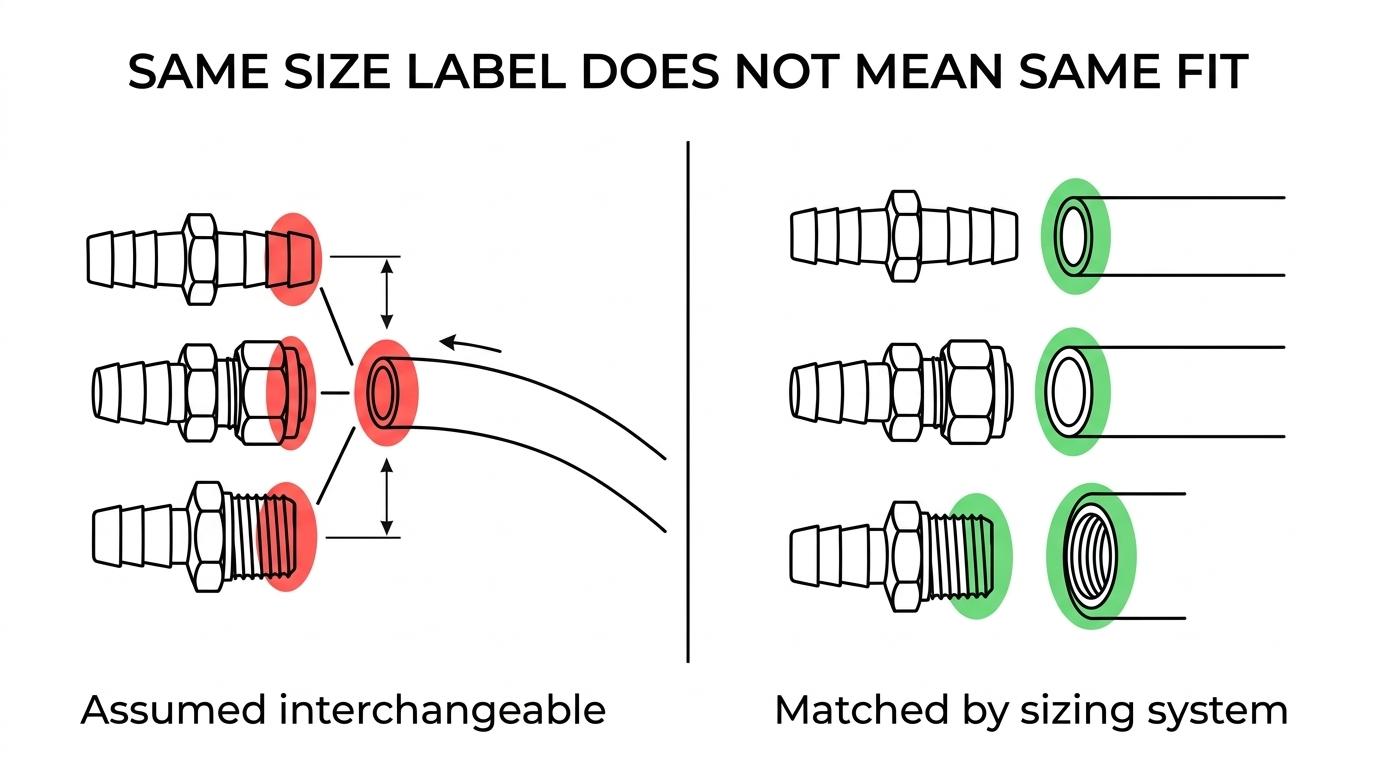
- Mini hose barb size matches hose inside diameter, while pipe threads use a nominal designation, so a one quarter inch hose barb and a one quarter inch NPT fitting are not interchangeable.
- Use plain barb splicers for simple hose-to-hose joins, threaded or compression fittings combinations for transitions, and clamps when tubing material, vibration, or pressure call for added retention.
- If the joint must seal on a flare seat instead of gripping tubing ID, mini hose barbs are the wrong fitting family and inverted flare brass fittings are the better choice.
That distinction matters because compact runs often combine several connection methods in a very small envelope. Once you separate hose ID sizing from thread sizing and then match the right shape to the routing path, mini hose barbs become much easier to specify.
What is a mini hose barb, and why does shape matter in compact tubing runs?
Mini hose barbs are small tube fittings that grip a hose by its inside diameter, and Industrial Parts Fittings treats shape as a primary selection factor because elbows, tees, and bulkhead forms solve different routing problems.
A hose barb uses one or more ridges to grip the tubing wall from the inside. In a compact assembly, that grip is only part of the story. The fitting geometry controls whether the tube has to bend sharply, whether flow splits into a branch, and whether a line can pass through a panel or bracket cleanly.
A common misconception is that any small barb will work if the diameter looks close enough. In practice, tight layouts punish bad geometry quickly. An inline splicer may fit the hose size perfectly and still create a kink if the tube has to turn immediately after the connection.
"Industrial Parts Fittings lists mini hose barb configurations including elbows, tees, bulkhead splicers, splicers, plugs, male pipe, female pipe, and compression variants."
In other words, the design choice is usually: what path must the tubing take, and what does it need to connect to at each end? Size comes next, but shape often decides whether the run is stable, serviceable, and leak resistant.
How are mini hose barbs sized correctly?
Mini hose barbs are sized by hose inside diameter, and Industrial Parts Fittings distinguishes that from thread and tube-OD sizing because those systems are not interchangeable.
If the tubing is one quarter inch ID, start with a one quarter inch barb. Do not size from the outside of the barb and do not assume that a one quarter inch label always means the same thing. A one quarter inch NPT male fitting, a one quarter inch compression fitting for tube OD, and a one quarter inch hose barb each reference a different sizing system.
That sounds basic, but it causes frequent ordering mistakes in procurement and maintenance. If the spec says hose, think inside diameter. If it says compression tube, think tube outside diameter. If it says NPT, think nominal pipe thread size.
"Industrial Parts Fittings notes that a one quarter inch NPT male, a one quarter inch tube OD compression fitting, and a one quarter inch hose barb are real products, but they are not interchangeable."
Here is the practical rule: if the connection seals by gripping flexible tubing, size by hose ID. If it seals with threads or ferrules, use that system’s dimensions instead. A slightly oversized barb can overstress thin tubing, while an undersized barb can slip even when clamped.
What mini hose barb shapes and end styles show up most often in compact tubing runs?
The most useful mini hose barb options fall into a small set of geometries and transition styles. In tight assemblies, each one solves a distinct layout problem.
It helps to think in two groups. First, there are pure routing shapes, like straight splicers, elbows, and tees. Second, there are transition styles, which let soft tubing connect to pipe threads, panel walls, or rigid tubing systems.
- Straight splicer: joins two hose ends in a straight line with minimal routing change.
- Elbow barb: turns the run, often ninety degrees, to reduce hose kinking near corners.
- Tee barb: creates a branch, bypass, vent, or return leg.
- Plug: closes an unused hose end or temporary test line.
- Bulkhead splicer: passes through a panel or bracket while connecting tubing on both sides.
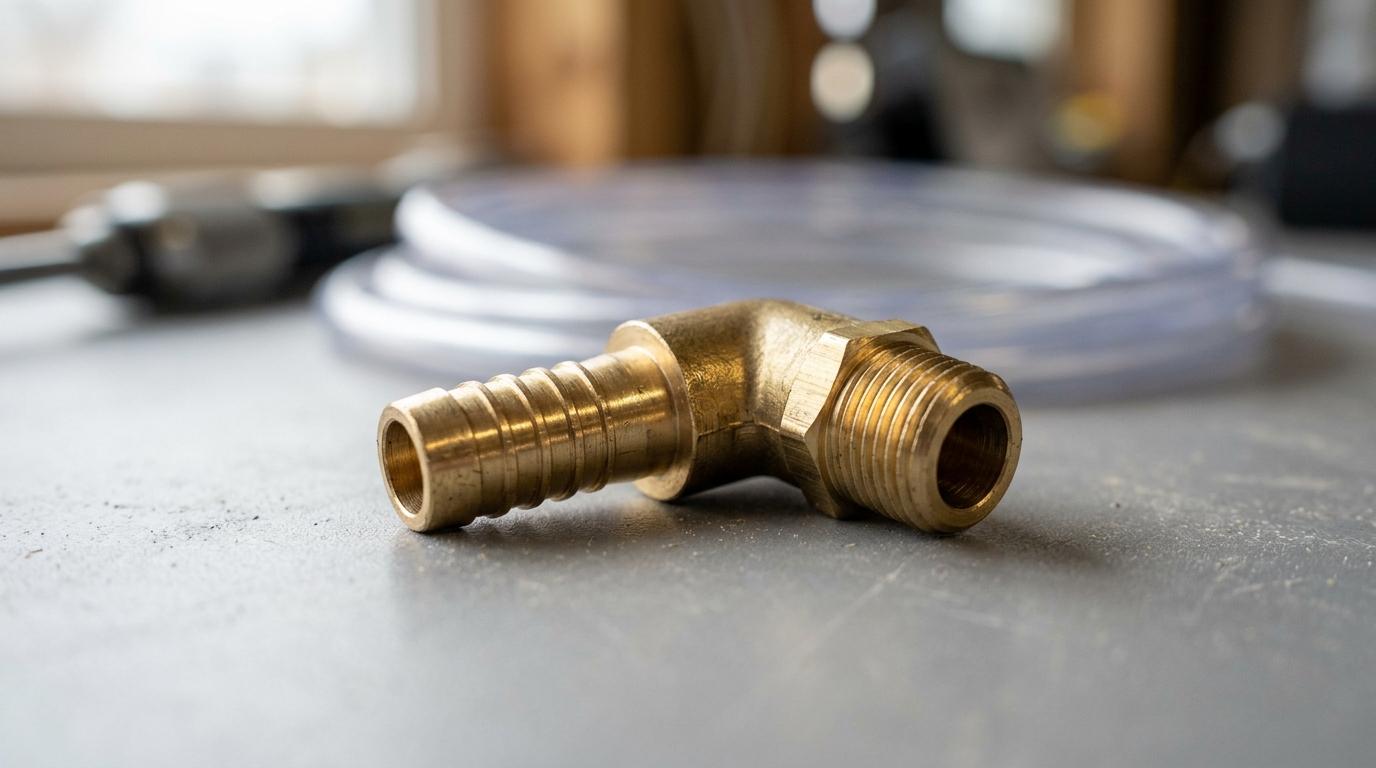
- Male pipe x barb: transitions from flexible tubing to a male threaded pipe connection.
- Female pipe x barb: connects tubing to a female threaded component or port.
- Compression x barb: joins flexible hose to a rigid tube or tube-fitting segment.
- Hose-coupling thread adapter: connects a barb assembly to standardized hose-coupling threads where that interface is required.
The ninth item matters because not every threaded hose connection is just pipe thread. ASME B1.20.7 addresses hose coupling screw threads for direct hose connections in normal sizes from one half inch through four inches, so if a drawing calls out a hose coupling thread, it should not be treated as generic pipe thread.
How do you choose the right mini hose barb shape for routing and flow?
Choose the shape by following the tubing path first, the branch requirement second, and the service-access requirement third. That order prevents most compact-run mistakes.
Start with direction changes. If the tubing must turn immediately after the fitting, an elbow usually beats forcing a bend into the hose itself. This is a quiet but important design improvement because the fitting can carry the change in direction without asking the tube wall to collapse around a tight radius.
Next, check whether the line is single path or branched. If one source feeds two short legs, or one drain line needs a vent or bypass, a tee is the natural shape. If there is no branch and no direction change, a straight splicer keeps the run simpler.
Last, think about mounting and service. If the line must cross a panel, use a bulkhead style. If the line may be capped for flushing, sampling, or future expansion, a plug can turn into a useful maintenance feature instead of an afterthought.
When should you use a straight splicer instead of an elbow or tee?
Use a straight splicer when the line stays inline and you want the fewest disturbances, while elbows and tees are better when the layout demands turning or branching.
A straight splicer is the simplest flow path. It usually takes less space along the centerline, introduces no extra branch cavity, and keeps the joint concept easy for service technicians. If the hose enters and leaves on the same axis, it is hard to beat.
An elbow earns its place when the alternative is a forced bend right at the connection. A common mistake is assuming an elbow adds complexity, so it should be avoided. In compact runs, the opposite is often true. The elbow can reduce tubing stress, prevent flattening, and make the assembly repeatable.
A tee is best when the branch is intentional. If you do not need that third leg, do not add it. Extra branches can trap fluid or air, add another leak path, and complicate flushing.
How do threaded mini hose barb ends differ from plain barb splicers?
Threaded mini hose barb ends transition between hose and a port, while plain splicers only join hose to hose. The difference affects size callouts, sealing method, and standards.
A plain splicer is selected mainly by hose ID. A threaded barb adapter has two sizing languages on one part, with the barb sized to hose ID and the thread sized by its own standard. That is why mixed-end parts deserve extra care on drawings, BOMs, and purchase orders.
NIST documentation shows the kind of mixed-end configuration seen often in real equipment, including a one quarter inch NPTM end paired with a hose barb end. That type of adapter is common when flexible tubing must connect to a valve body, manifold, or instrument port.
When the threaded side is a hose coupling thread rather than pipe thread, the terminology matters even more. ASME B1.20.7 describes the threaded parts of hose couplings, valves, and nozzles used in direct hose connection. It also notes the normal sequence of connection, in relation to flow direction, from an externally threaded nipple into an internally threaded coupling. If the print says hose coupling screw thread, do not substitute NPT by habit.
How do you connect mini hose barbs to pipe threads or compression fittings?
Connect mini hose barbs to pipe threads when the system ends at a threaded port, and use compression transitions when the next segment is rigid tubing rather than flexible hose.
The first question is what the hose must meet on the other side. If it is a valve, pump, regulator, or manifold port, a barb-to-pipe-thread fitting is often the direct path. If it is small metal or rigid plastic tubing, a compression-to-barb fitting can simplify the change from flexible to rigid line without adding extra adapters.
"Industrial Parts Fittings identifies mini-barb-to-pipe and mini-barb-to-compression combinations as part of its mini hose barb lineup."
A practical sequence helps. Identify the hose ID on the soft-tube side, identify the actual thread or tube-OD requirement on the other side, and verify the sealing method for each interface. If the port is NPT, the thread seals differently than the barb end. If the rigid side is compression, the ferrule and tube OD matter more than the hose dimensions.
How should you install and clamp a mini hose barb connection?
Install mini hose barbs by matching the hose ID, fully seating the tube over the barb, and adding the right clamp when material, vibration, or duty conditions require extra retention.
For many compact runs, installation discipline matters as much as part selection. NIST-hosted equipment documentation notes that hose-barb connections may be secured with a spring or band hose clamp, which is a useful reminder that retention choices depend on service conditions, not just fitting size.
- Inspect the tube: confirm the hose ID and check that the cut end is round, clean, and free of splits.
- Seat the tubing fully: push the tube past the barb ridges until it bottoms as intended on the fitting shank.
- Place the clamp correctly: position a spring or band clamp over the barb engagement area, not out on the unsupported tube.
- Test under real conditions: check for leaks after pressure, temperature, or vibration are introduced.
A useful service tip is to plan for removal before installation. Hose-barb joints grip aggressively by design, and tubing often must be cut off during maintenance rather than twisted loose. That is normal, not a failure.
Are mini hose barbs better than compression fittings or inverted flare brass fittings?
Mini hose barbs are better for flexible tubing, compression fittings are better for rigid tube OD, and inverted flare brass fittings are better when the seal must form on a flare seat.
These fitting families solve different sealing problems. A hose barb grips the inside diameter of flexible tubing. A compression fitting seals by ferrule action around the tube outside diameter. An inverted flare fitting seals on a formed flare, commonly in brake line and fuel line style connections.
If the tubing is soft and needs quick, compact routing, mini hose barbs are often the simplest answer. If the line is rigid copper, brass, or plastic tube and repeatable tube-OD sealing matters, compression fittings fit better. If the assembly needs a flare seat and mechanical flare nut retention, a barb is the wrong category altogether.
That distinction is especially useful for buyers who work across mixed systems. A hose connection and a flare connection may look similarly small on paper, but they are not substitutes. If the print or component family points toward flare geometry, move to inverted flare brass fittings rather than trying to adapt a barb into the job.
What common mistakes cause leaks or damaged tubing in compact runs?
Most mini hose barb failures come from size confusion, bad routing, or poor retention. The fitting is often blamed when the real issue is specification or installation.
A common mistake is ordering by what looks close in diameter instead of matching the hose ID exactly. Another is forcing a bend immediately after a straight barb when an elbow should have been used. Both errors can make a sound brass fitting behave like the weak point in the line.
- Wrong size system: ordering by NPT or tube OD when the barb should match hose inside diameter.
- Sharp post-fitting bend: using a straight splicer where an elbow would reduce hose collapse.
- Under-insertion: leaving part of the barb engagement length exposed, which reduces grip.
- Clamp mismatch: over-tightening soft tube or skipping a clamp where vibration calls for one.
- Assumed reusability: trying to pull old tubing off intact when cutting it away is the safer method.
The pattern is simple: if the tubing path, hose ID, and end style are all correct, mini hose barbs are usually straightforward. Problems rise fast when one of those three variables is guessed instead of specified.
Which standards and terms matter when specifying mini hose barbs?
The key terms are hose ID, tube OD, nominal thread designation, NPTM, and hose coupling screw threads. Those words define whether the part will fit before anyone touches a wrench.
On procurement documents, "one quarter inch" means very little by itself. Write whether it refers to hose inside diameter, tube outside diameter, or pipe thread size. That single clarification prevents many receiving and assembly errors.
For hose-coupling threads, ASME B1.20.7 is the relevant reference point for the threaded parts of hose couplings, valves, nozzles, and related fittings used in direct hose service across specified normal sizes. For mixed-end adapters, NPTM clearly identifies a male pipe thread side, while the barb side still needs its own hose-ID callout.
One last practical rule helps across engineering, purchasing, and maintenance: if the fitting name does not state both connection systems, ask for them. "Mini hose barb adapter" is incomplete. "One quarter inch hose ID x one quarter inch NPTM" is usable. That level of detail keeps compact tubing runs compact on the bench, not just on the drawing.
Keywords:
mini hose barbs