How Hose Material Changes Barb and Clamp Selection
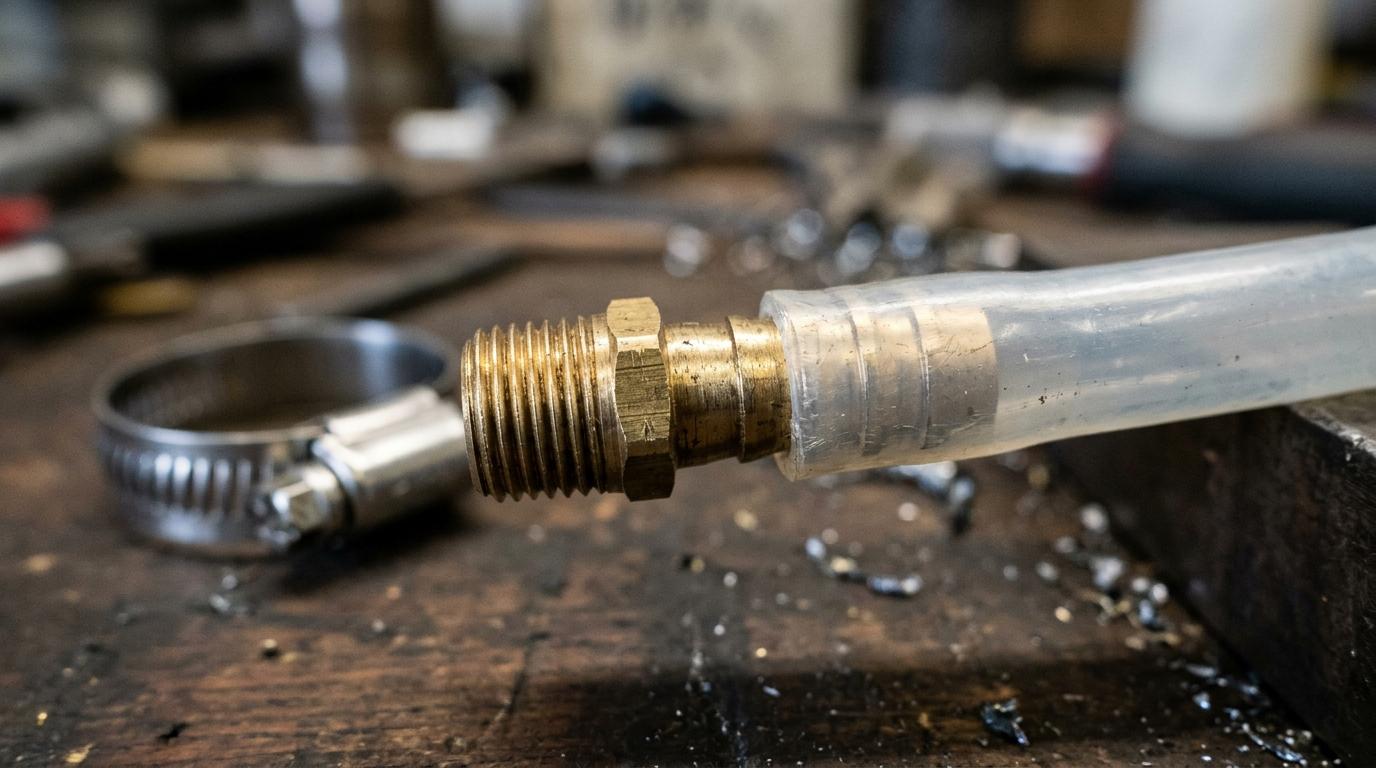
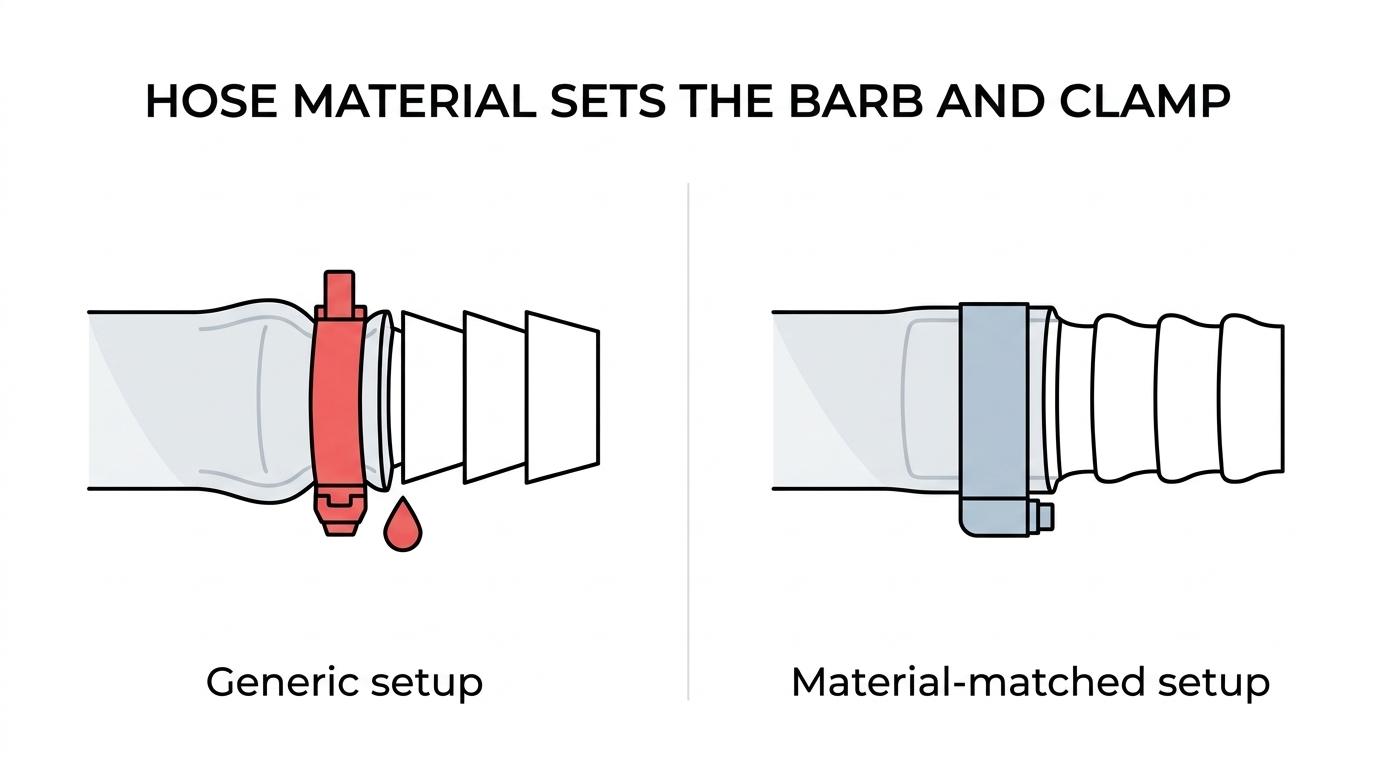
A hose barb connection can look simple: match the nominal size, slide the hose on, add a clamp, and move on. In practice, hose material changes nearly every part of that decision. A barb that works well with soft silicone may be a poor match for stiff nylon. A clamp that holds braided hose securely may deform thin-wall tubing. Even when two hoses share the same nominal inside diameter, they can need different barb geometry, different clamp sizing, and a different retention method.
That is why hose barb clamp selection should start with the hose itself, not just the fitting catalog. Purdue Extension notes that hose inside diameter determines fitting size, while hose outside diameter determines clamp size. It also points out that chemical incompatibility can make a hose lining brittle, stiff, or soft over time, which changes sealing behavior and service life. In other words, the right answer is not driven by size alone.
Why hose material changes barb and clamp selection
Hose material affects grip, elasticity, sealing, pull-off resistance, and how the clamp load spreads around the barb. Soft tubing can conform to the barb quickly and create a good seal with modest compression. That sounds ideal, but there is a catch: if clamp force is too high, the tubing can distort, lift between barb lands, or even tear under vibration. Manufacturer guidance on hose barb performance has shown that soft tubing often needs less clamp force, not more.
Stiffer tubing creates a different problem. It resists stretching over the barb and may not recover tightly enough to hold without a stronger retention method. A shallow barb that works on flexible tubing can allow harder tubing to slip off with less pull than expected. In higher-pressure service, tubing expansion can reduce the barb’s grip, which lowers blow-off resistance.
Material compatibility matters just as much as mechanical fit. If the hose compound is not compatible with the fluid it carries, the hose can soften, harden, swell, or crack. A connection that passed inspection on day one may be much less secure later.
A few material-driven patterns show up again and again:
- Soft silicone or soft PVC: good conformity, lower clamp force, higher risk of overcompression
- Reinforced rubber hose: better retention under pressure, often benefits from wider clamp bands
- Braided tubing: thicker wall, different compression target, often needs more secure retention
- Stiff nylon tubing: harder to seat, higher pull-off risk with shallow barb designs
Hose ID and hose OD affect barb size and clamp size
One of the most common sourcing mistakes is treating hose size as a single dimension. It is not. Hose inside diameter, or hose ID, is used to size the barb. Hose outside diameter, or hose OD, is used to size the clamp. That sounds basic, yet it is where many field leaks begin.
Two hoses labeled with the same nominal size can have very different wall thicknesses. One may be thin-wall and flexible, another may be thick-wall and reinforced. Both may fit the same barb size by ID, but they will not use the same clamp range by OD. The clamp decision changes because the material and construction change.
The table below shows how that plays out in real selection work.
| Hose material or construction | Barb sizing note | Clamp sizing note | Common risk |
|---|---|---|---|
| Soft silicone | Size by hose ID, avoid aggressive barb edges | Clamp by installed hose OD, use moderate compression | Overclamping, tube lift, tearing |
| PVC tubing | Size by hose ID, check flexibility at service temperature | Clamp by OD, watch cold-temperature stiffness | Cracking after thermal cycling |
| Rubber fuel hose | Size by hose ID, barb engagement matters under vibration | Clamp by OD, constant tension styles are often a strong option | Relaxation over time |
| Braided reinforced hose | Size by hose ID, insertion force may be higher | Clamp by OD over reinforcement, wider band can help load spread | Poor seal if clamp is undersized |
| Nylon or stiff thermoplastic | Size by hose ID, shallow barb may not retain well | Clamp by OD, higher closing force may be needed | Pull-off with vibration or pressure spikes |
This is also why nominal size alone is not enough on a quote request. Procurement teams and technicians get better results when they provide hose material, hose ID, hose OD, wall style, fluid, pressure, and temperature range up front.
Durometer and barb profile change clamp force needs
Durometer is a simple way to describe how soft or hard the hose material feels. It has a direct effect on clamp force and barb performance. Harder tubing usually needs more closing force to reach proper compression. Softer tubing reaches that compression with less force, and too much force can create a leak rather than prevent one.
Barb profile matters too. A sharp, aggressive barb may bite into very soft tubing and improve retention at first, yet that same sharp edge can cut the tube under pull or vibration. A more rounded barb is gentler on soft hose, but with stiff tubing it may not create enough mechanical hold.
This is where percent compression becomes useful. Clamp suppliers often publish target compression ranges by tubing type. Typical guidance can fall around fifteen to twenty percent for very soft silicone, twenty to thirty percent for silicone and TPE, and twenty-five to thirty percent for braided tubing. Those numbers are not a universal rule, but they show why one clamp setting does not fit every hose.
A useful check is to look for both sealing and tube condition after installation.
- Too little compression: rotation on the barb, weeping, low pull-off resistance
- Too much compression: extrusion, tube cut marks, lifted material between barb lands
- Good compression: stable seal, no visible damage, consistent retention after cycling
Some fuel-line guidance also points toward hose material around eighty-five Shore A for hose barb use, with constant tension spring band clamps as a strong match in many cases. The reason is practical: a clamp that keeps load more consistent through heat and vibration can hold better than a rigid clamp that loosens as the hose relaxes.
Pressure, vibration, and retention method affect pull-off resistance
Low-pressure drain or transfer service is very different from pulsating fuel delivery, air systems, or equipment exposed to constant vibration. The same barb and clamp combination should not be assumed safe across all of them.
Pressure works against hose retention in two ways. First, it pushes the hose outward, which can reduce the barb’s grip. Second, it adds axial force that can drive the hose off the fitting. Vibration compounds the problem by fretting the interface and changing clamp load over time. That is why pull-off resistance and blow-off resistance matter so much in hose barb applications.
Purdue Extension points out that crimp fittings can force barbs through the rubber and into nylon braid, holding the hose more securely during use. That is a strong reminder that the retention method is part of the design, not an accessory choice made at the end.
When service gets more demanding, the retention method should step up with it.
- Short, low-pressure utility lines
- Vibration-prone mobile equipment
- Heated fluid transfer circuits
- Reinforced hose with pressure spikes
Those are not equal cases, and they should not get the same clamp by default.
Choosing clamp types for rubber, silicone, PVC, and braided hose
Clamp style changes how force is applied around the hose and how well that force holds over time. A worm-drive clamp is common and easy to source, but it can create localized loading if the band and housing are not a good match for the hose wall. Ear clamps create a controlled installed diameter and are often used where consistent compression matters. Spring band clamps maintain load as the hose expands and contracts, which is why they are often preferred in fuel and thermal cycling service. Crimp sleeves or ferrules are often chosen when retention requirements go beyond what a field-installed clamp can reliably deliver.
The best clamp is the one that matches both the hose material and the service conditions.
- Soft tubing: smoother band surfaces and controlled compression help prevent damage
- Rubber hose: spring band or properly sized ear clamps often perform well under heat and vibration
- Braided hose: wider band contact and stronger retention methods reduce localized distortion
- Stiff thermoplastic: careful sizing is critical because the hose may not recover tightly after installation
Clamp width matters as well. A wider band can spread force over more surface area, which may reduce leakage on certain hose constructions. Installation method matters just as much. A good clamp installed poorly can create the same failure pattern as a bad clamp choice.
When hose barb connections should give way to flare fittings
Sometimes the best hose barb clamp selection is no hose barb at all.
If the application is moving toward rigid tube connections, higher-pressure service, repeated maintenance cycles, or safety-sensitive fuel and brake routing, flare-style connections often deserve a look. This is where teams frequently shift from barbed hose connections to tube fittings, brass adapters, or SAE inverted flare fittings that create a more controlled metal-to-metal sealing interface.
For buyers comparing connection methods across a mixed system, it can help to review inverted flare brass fittings alongside hose barb options. That is especially true when the line set includes both flexible hose sections and hard tube terminations. In many assemblies, the strongest design choice is not about forcing one fitting style everywhere. It is about using barbs where flexible hose is appropriate and using flare and inverted flare fittings where tube retention and serviceability matter more.
Questions to confirm before ordering hose barbs and clamps
Selection gets much easier when a few details are confirmed early. Many returns, leaks, and field retrofits come back to missing one of these points.
- Hose material: silicone, PVC, rubber, TPE, nylon, or braided construction
- Hose ID: the dimension used to size the barb
- Hose OD: the installed dimension used to size the clamp
- Durometer: how soft or stiff the hose behaves under compression
- System conditions: pressure, vacuum, pulsation, vibration, and temperature
- Fluid compatibility: whether the hose compound changes when exposed to the media
- Retention method: clamp, ear clamp, spring band, or crimped assembly
A hose barb connection only looks simple when the hose details are ignored. Once material, durometer, wall construction, pressure, and clamp behavior are considered together, the selection becomes much more precise, and much more reliable.
Keywords:
hose barb clamp selection