Selecting Industrial Ball Valves: Full Port vs Standard Port, Seat Materials, and Pressure Ratings
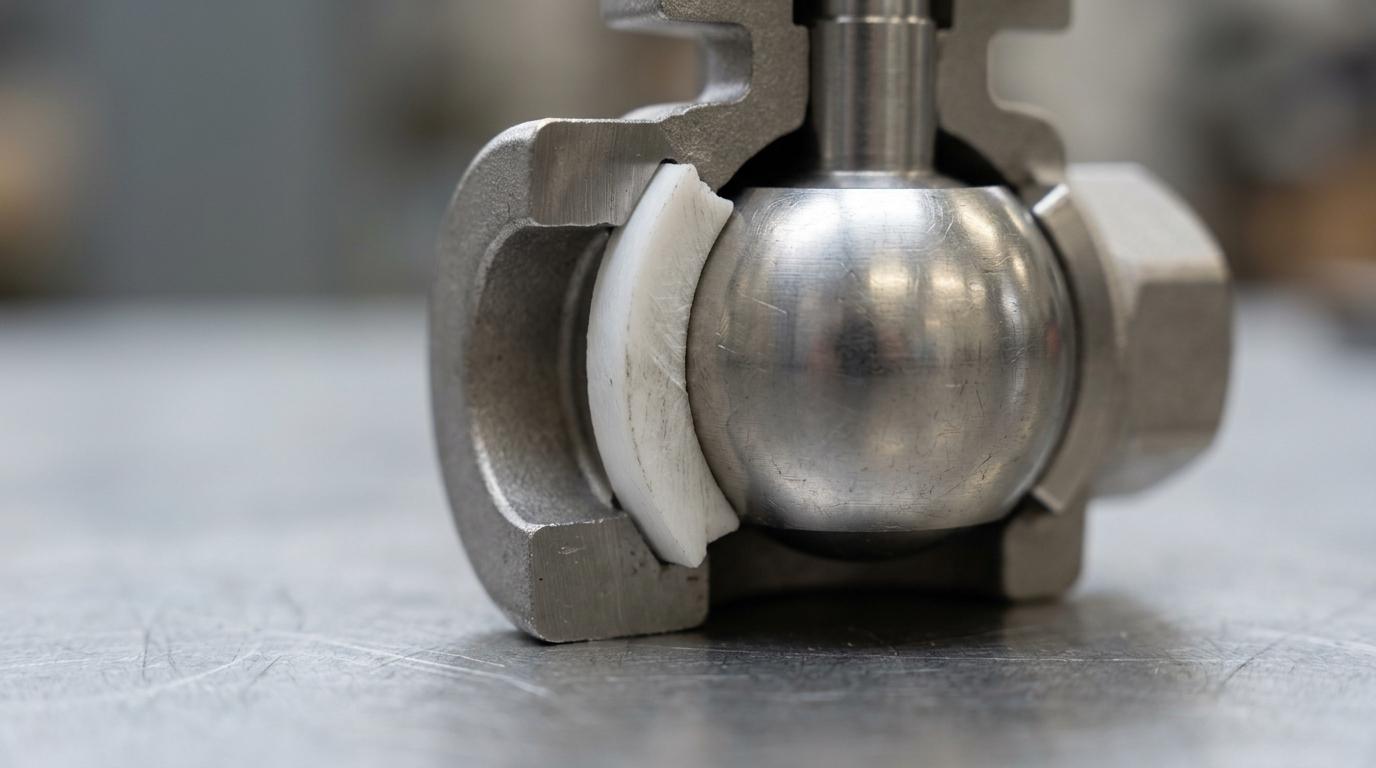
Choosing a ball valve looks straightforward until the service conditions start stacking up.
A valve that opens and closes cleanly on day one can still be the wrong choice if it adds avoidable pressure drop, struggles with temperature, or wears through its seats far earlier than expected. In industrial systems, that difference shows up in pump load, cycle life, maintenance intervals, and downtime.
Port style, seat material, and pressure class are not separate checkboxes. They work together.
Full Port vs Standard Port Ball Valve: How Bore Size Changes Flow
The first decision is often the most visible one: full port or standard port.
A full port ball valve has an internal bore that closely matches the inside diameter of the connected pipe. When the valve is open, the flow path stays nearly uniform through the body. A standard port valve, sometimes called reduced port or reduced bore, has a smaller opening through the ball than the pipe itself. That smaller opening creates a built-in restriction.
That geometric difference affects more than flow rate. It changes velocity through the valve, pressure drop across the line, pump demand, and whether cleaning pigs or line tools can pass through the valve body.
| Feature | Full Port Ball Valve | Standard Port Ball Valve |
|---|---|---|
| Bore size | Near pipe ID | Smaller than pipe ID |
| Pressure drop | Very low | Higher |
| Flow coefficient (Cv) | Higher | Lower |
| Pigging capability | Typically suitable | Usually not suitable |
| Size and weight | Larger, heavier | More compact |
| Initial cost | Higher | Lower |
| Best fit | High-flow, low-loss service | General service where some restriction is acceptable |
In systems with meaningful flow rates, the difference can be significant. A reduced port valve can multiply the pressure drop compared with a full port valve of the same line size. That may not matter on a short branch line carrying intermittent flow. It matters a great deal when pumps are already close to their curve limits, when energy cost is under review, or when the line needs every bit of available capacity.
A full port valve also tends to be the safer choice in dirty service, slurry-adjacent duty, and lines that may need flushing or pigging. Reduced bores create a point of acceleration and turbulence, which can raise wear and increase the chance of debris hang-up.
When the process priority is clear, the port choice usually becomes clear as well.
- Choose full port when: pressure loss must stay low
- Choose full port when: line pigging or aggressive flushing is required
- Choose full port when: solids or debris may collect at restrictions
- compact footprint
- lower valve weight
- lower initial purchase cost
Standard port valves still have a strong place in industrial service. They are often a smart fit for utility lines, branch circuits, instrumentation-related piping, and systems where a modest pressure drop is acceptable. They are smaller, lighter, and usually less expensive, which can matter when space is limited or when many valves are being specified across a large project.
A reduced port valve is not automatically a compromise. It is a targeted choice. The question is whether the system can afford the restriction.
Ball Valve Seat Materials: PTFE, RPTFE, PEEK, and Metal Seats
If port style defines how the valve handles flow, the seat material defines how it seals, cycles, and survives.
Seats are often the first component to set the real operating limit of a ball valve. A body may have the strength for the pressure class, but the seat still has to tolerate the media, the temperature, the cycling frequency, and the differential pressure across the closed ball.
| Seat Material | Typical Strengths | Typical Limits | Common Service Fit |
|---|---|---|---|
| PTFE | Excellent chemical resistance, low torque, tight shutoff | Can creep under high pressure and heat | Water, chemicals, general service |
| RPTFE | Better wear resistance and dimensional stability than PTFE | Slightly less chemically inert than virgin PTFE | Higher-cycle general industrial duty |
| PEEK | High strength, good high-pressure performance, better heat resistance | Higher cost, not ideal for every aggressive chemical | Oil and gas, high-pressure process lines |
| Metal Seats | Withstand very high temperature and abrasive media | Higher torque, more exacting repair and machining | Severe service, hot media, erosive duty |
PTFE remains the benchmark for many general-service ball valves because it seals well, resists a broad range of chemicals, and keeps operating torque low. That makes it a reliable choice for clean liquids, many process chemicals, water service, and a wide range of non-abrasive media. Its weak point is mechanical strength at higher pressure and temperature. Under tougher conditions, it can deform, creep, or extrude.
RPTFE, or reinforced PTFE, is often the next step when PTFE performance is close but not quite enough. Fillers improve wear resistance, reduce thermal expansion, and give the seat more stability under load. In many industrial applications, that translates into longer life without giving up the familiar sealing behavior of PTFE-based seats.
Many general-service industrial ball valves operate very well in this PTFE family.
PEEK moves the conversation toward high-pressure and higher-temperature duty. It is much harder and stronger than PTFE, and it tends to hold its shape under load very well. That makes it attractive in applications with repeated cycling, elevated pressure, and more demanding service conditions. The tradeoff is cost, along with the need to verify chemical compatibility rather than assuming it.
Industrial valves sit in a different category. They are chosen when soft seats are likely to fail from temperature, erosion, solids, or extreme cycling demands. A well-designed metal-seated ball valve can handle service conditions that would quickly damage polymer seats, but it usually needs higher seating force and may require more torque to operate. Repair can also be more specialized because the sealing surfaces depend on precision metal-to-metal contact.
Seat selection is easier when the service conditions are ranked in order of importance.
- Best for low torque and chemical resistance: PTFE
- Best for longer wear in general industrial duty: RPTFE
- Best for high pressure with demanding cycle life: PEEK
- abrasive media and very hot service
- severe-duty shutoff where soft seats will not last
A common mistake is choosing the seat by media alone. Chemical compatibility matters, but so do pressure spikes, thermal cycling, frequency of operation, and any solids carried by the flow. A clean chemical line and an abrasive process stream may share the same pressure rating on paper while needing completely different seat materials in practice.
Ball Valve Pressure Ratings: ANSI Classes, Temperature Limits, and What the Numbers Mean
Pressure class is where many selection errors begin.
A Class 150 valve does not mean the valve is rated for 150 psi. In standard ASME valve classifications, the class number is a designation tied to pressure-temperature tables and material groups. At ambient conditions, a carbon steel Class 150 valve is typically rated around 285 psi, while higher classes rise substantially from there.
| ANSI Class | Approximate Working Pressure at Ambient for Carbon Steel |
|---|---|
| 150 | ~285 psi |
| 300 | ~742 psi |
| 600 | ~1481 psi |
| 1500 | ~3702 psi |
Those values are only a starting point. The real limit depends on body material, temperature, valve construction, and the manufacturer’s published pressure-temperature data.
Temperature changes everything. As temperature rises, allowable working pressure falls because the strength of the valve material drops. Seat material can reduce the limit even sooner than the body does. A valve body may belong to a high pressure class, yet the actual application limit may still be governed by a PTFE seat, stem packing, or seal design.
That is why a “high-class” valve is not automatically a high-temperature valve.
Testing standards build in margin, which helps, but that should not be mistaken for operating room. Industrial valves are commonly shell-tested above working pressure and seat-tested above normal shutoff pressure, yet those test levels are not invitations to run near the edge every day. Long-term reliability is much better when normal service stays comfortably inside the valve’s published pressure-temperature envelope.
A solid rating check should cover more than steady-state line pressure.
- Check the upset case: startup spikes, surge, deadhead conditions
- Check the temperature case: normal operation plus excursions and cleaning cycles
- Check the seat limit: this is often the first component to reach its boundary
- Check the connection style: threaded brass and flanged steel are built for very different service ranges
For lower-pressure utility service, brass or bronze ball valves with PTFE-based seats are often a practical fit. For higher pressure process systems, steel or stainless steel bodies, stronger seat materials, and heavier-duty stem and body construction become more appropriate. Once pressures move into more demanding classes, the whole valve architecture changes, not just the number stamped on the nameplate.
Reading Ball Valve Specifications Before You Buy
Catalog pages and datasheets can shorten the selection process, but only if the right fields are being checked.
A useful product listing should show valve size, end connection, body and trim material, seat material, pressure rating, temperature limit, and any relevant certifications or standards. Some listings also include Cv, dimensions, actuator mounting details, and seal materials. That is enough information to narrow options quickly, especially when comparing brass, stainless, and carbon steel ball valves across multiple service types.
For procurement teams and engineers, the fastest path is usually to treat the datasheet as a screening tool first and a final confirmation tool second. Compare the service conditions against the valve’s bore type, seat, class, and compliance data. Then confirm application details that often get missed, including cycle frequency, media cleanliness, and whether future operating conditions may be more demanding than current ones.
A supplier with broad catalog coverage can be especially helpful here. Standard valves solve many jobs quickly, while custom-machined or modified components can close the gap when the exact combination of port style, material, end connection, or compliance requirement is not sitting on the shelf.
A practical review process keeps the choice grounded.
- Define the real service conditions, including maximum pressure, maximum temperature, media, and cycling frequency.
- Decide whether full port is needed for flow efficiency, pigging, solids handling, or future line capacity.
- Match the seat material to chemistry, heat, wear, and shutoff expectations.
- Confirm the valve class, end style, standards, and torque or actuation needs before issuing the order.
A carefully selected ball valve is a small part of a much larger system, yet it can shape that system’s efficiency for years. When bore size, seat material, and pressure class are chosen together rather than in isolation, the result is a valve package that fits the process instead of forcing the process to work around it.
Keywords:
full port vs standard port ball valve