How to Prevent Galling, Stripped Threads, and Cracked Fittings in Brass Assemblies
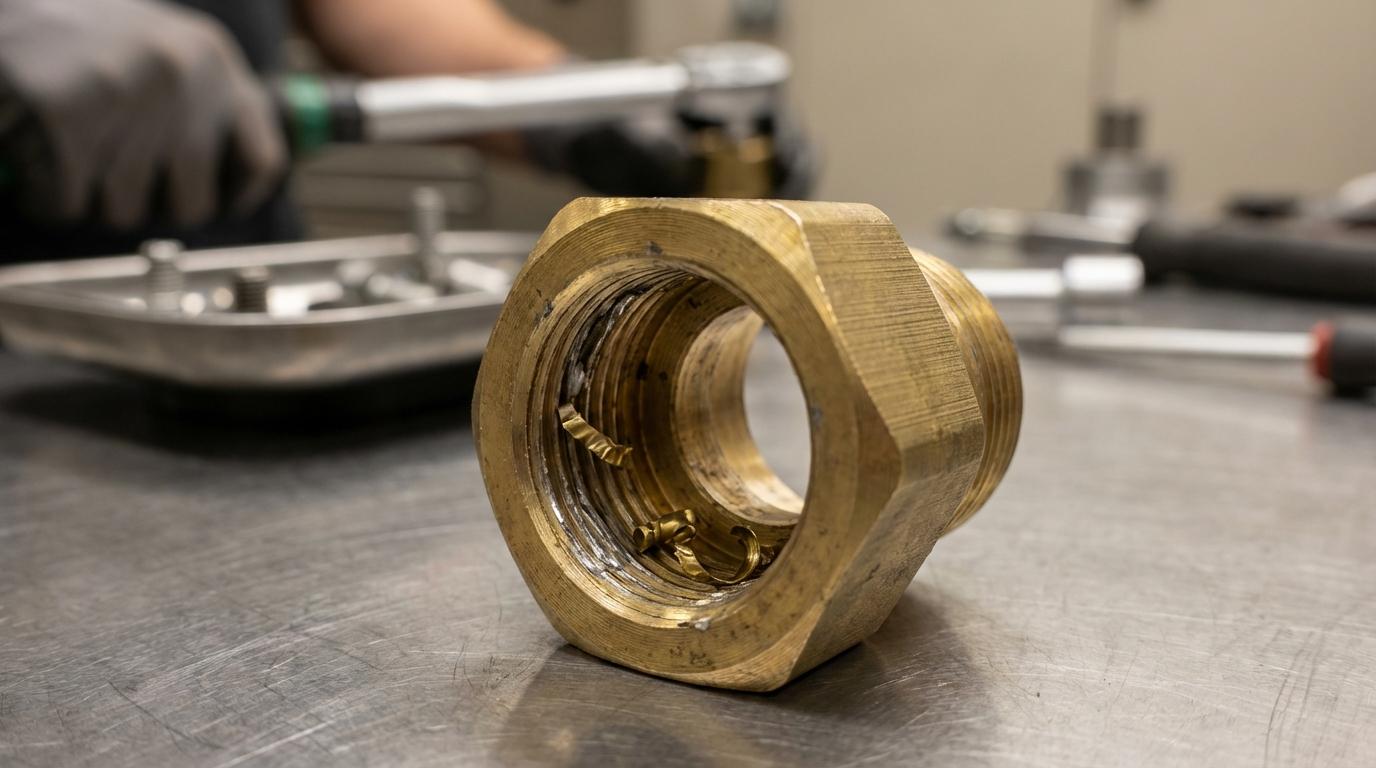
Brass fittings earn their place in fluid and air systems because they machine cleanly, resist many forms of corrosion, and seal well across a wide range of pressures. Yet the same material traits that make brass pleasant to work with, relatively low shear strength and a tendency to deform before it breaks, also set it up for a few familiar failure modes: threads that strip, threads that seize, and bodies that crack when stress and chemistry team up.
The good news is that most of these issues are preventable with a disciplined approach that connects installation technique, torque control, lubrication, and smarter specification upstream.
Why brass threads fail when everything looks fine
Threaded joints succeed or fail at the interfaces you cannot see: the flanks of the threads, the first engaged threads near the opening, and any sharp internal corners. Brass is forgiving in the sense that it will deform instead of snapping suddenly, but that forgiveness can hide damage until a joint starts to leak, loosens under vibration, or fails during maintenance.
Three patterns show up repeatedly across industrial service:
- Stripped threads: the brass yields in shear at the thread flanks and the fastener spins without building clamp load.
- Galling and seizure: localized adhesion and tearing raise friction so quickly that torque becomes a poor proxy for preload.
- Cracking: stress corrosion cracking or corrosion-assisted cracking starts at stress risers and grows with little exterior warning.
Each pattern has a different “physics of failure,” which is why a single rule like “tighten more” or “use tape” can make one problem better while making another worse.
Stripped threads are usually a torque and friction problem
Stripped threads are rarely mysterious. They are typically the result of one of these conditions:
- Excessive torque for the thread size and alloy
- High friction that inflates torque without increasing useful clamp load
- Cross-threading or damaged lead threads that concentrate load on a small area
- Repeated reuse that has already cold-worked and worn the thread flanks
Brass threads fail in shear. The first few engaged threads carry a disproportionate share of the load, so any misalignment, burr, or out-of-round condition can push those threads past yield while the rest of the engagement is barely working.
A practical mindset shift helps: torque is not the goal. The goal is enough preload and proper geometry to seal and resist loosening, achieved without exceeding the brass’s local shear capacity.
Galling: less common than stainless, still costly when it happens
Galling is often associated with stainless on stainless, but brass assemblies can gall too, especially under these conditions:
- Dirty or rough threads
- High tightening speed with heat generation
- Rework cycles where debris is already embedded in the softer metal
- Mating combinations that promote adhesion under pressure
Once galling starts, friction climbs sharply. The operator feels “it’s getting tight,” applies more torque, and the joint can jump straight into thread stripping or body cracking. If you have ever seen torn, shiny smears along the thread flanks, that is the signature.
Cracked fittings: stress plus environment, not bad luck
Cracking in brass is often driven by chemistry that selectively attacks the alloy while the fitting is under tensile stress from tightening, internal pressure, bending loads, or residual manufacturing stress.
Two environmental culprits deserve special respect:
- Chlorinated or chloride-containing water: can promote dezincification in some brasses, leaving a weakened porous copper-rich structure.
- Ammonia and some nitrogen compounds: can trigger stress corrosion cracking even at low concentrations when tensile stress is present.
This matters because cracking can originate at an internal corner or thread root where it is hard to detect early. A joint can pass a pressure test, run for months, and then fail after thermal cycling or a maintenance retorque that adds just enough extra stress.
A quick map of symptoms to root causes
Small field signals can tell you which failure mode you are approaching. The table below is designed for technicians and engineers who need fast triage without guessing.
| What you see in the field | Likely mechanism | What to do immediately | What to change next time |
|---|---|---|---|
| Fitting spins and will not “snug up” | Thread stripping in brass (shear) | Stop, do not keep tightening, replace the damaged part | Set a torque method, reduce friction variability, consider a larger size or reinforced female threads |
| Torque rises suddenly, then feels gritty | Galling starting on thread flanks | Back off carefully, disassemble, inspect threads, replace if torn | Cleanliness controls, anti-seize or suitable lubricant, slower tightening, better surface finish |
| Hairline crack near a hex, socket, or internal corner | Stress corrosion cracking or overstress at a stress riser | Depressurize and replace, avoid retorque | Reduce tensile stress, remove bending loads, select DZR brass or alternate alloy, review fluid chemistry |
| Recurrent seepage after thermal cycles | Loss of preload or creep in soft metal | Verify alignment and support, reseal per spec | Choose the right sealing method, control torque, add strain relief and vibration management |
Assembly practices that protect brass threads
Most prevention happens in the first minute of assembly. The objective is repeatability: low variation in friction, good alignment, and a controlled path to preload.
Start by treating thread engagement as a precision operation, not a strength contest. That means hand-starting, inspecting, and using tools that can hit a target consistently.
After you have clean parts on the bench, the following habits make a measurable difference:
- Hand-start to full confidence: if you cannot get several turns by hand, stop and diagnose alignment or thread damage.
- Clean, then clean again: debris in threads is a friction multiplier and a galling accelerant.
- Slow tightening near seating: speed generates heat and masks the onset of galling.
A second layer is torque discipline. Published torque charts and manufacturer guidance are ideal. When guidance is not available, a controlled shop test program to establish safe installation torque can be more reliable than tribal knowledge, especially for small threads where the margin is thin.
Before adopting any lubricant or sealant, remember that torque to preload is friction-dependent. Lubricated threads can reach the same preload at a significantly lower torque, which is good for brass, but only if the torque target is adjusted to match.
Here is a compact set of practices that help teams standardize results across shifts and sites:
- Torque approach: Use a calibrated torque wrench for critical joints, and document the torque method (dry, lubricated, with tape, with paste).
- Lubricant choice: Use a compatible anti-seize or assembly lubricant when galling risk is present, especially in mixed-metal joints.
- Sealant use: Apply PTFE tape or anaerobic sealant sparingly and consistently, focused on sealing rather than compensating for poor thread fit.
- Thread type discipline: Do not mix NPT, BSPP, BSPT, flare, and compression sealing assumptions; each seals differently and loads threads differently.
- Tooling control: Avoid impact tools on brass threads unless the fitting system explicitly supports it.
Preventing cross-threading and thread damage during rework
Cross-threading is a first-contact failure. It often happens when a fitting is started at an angle, the lead threads are nicked, or the installer is working blind with limited swing.
A few mechanical tactics reduce the odds:
Use proper support and alignment so the female component is not being pulled sideways by piping weight. Add brackets or clamps so the fitting is not acting as a structural member. If a pipe has to be “persuaded” into place, the threads will pay the price.
When reworking joints, be realistic about brass’s softness. Threads that look “mostly fine” can still have smeared flanks that will fail on the next tightening cycle. If you see deformation, the safest move is replacement, not heroics.
Material and product choices that reduce thread failures upstream
Installation technique can only compensate so much. The part you specify sets the ceiling for performance.
When applications involve aggressive water chemistry, thermal cycling, or repeated maintenance, alloy selection and manufacturing method matter. Forged brass fittings generally offer more consistent grain structure and fewer internal defects than cast fittings, which improves toughness and reduces crack initiation sites. For potable and regulated service, lead-free brasses that meet common compliance requirements (including AB1953 and S3874 style rules, and CA2745-type lead-free compositions) can also be specified while still prioritizing mechanical reliability.
In corrosive water service, dezincification-resistant (DZR) brass is often worth the upgrade. It is a straightforward way to reduce one of the classic long-term weakening mechanisms without changing the rest of the system design.
For procurement teams, it helps to treat “brass” as a family, not a single material. A short sourcing checklist can save weeks of downtime later:
- Alloy callout clarity: Specify the brass grade when the environment is chemically demanding, not just “brass.”
- Manufacturing preference: Choose forged where strength, toughness, and consistency are priorities.
- Compliance fit: Match lead-free requirements and approvals to the actual service, including air brake and other regulated categories where applicable.
Industrial suppliers that cover both standard catalog fittings and custom-machined components can also help when a geometry change is the cleanest fix, like adding a radius to reduce a stress riser, increasing thread engagement length, or shifting to a different end connection that seals without loading threads as heavily.
Design tweaks that keep stress off threads
A brass fitting should not be asked to do double duty as both a seal and a structural beam. If a connected tube or hose imposes bending loads, the highest stress often lands at the first thread or a sharp internal corner.
Common design improvements include:
- Add strain relief so the joint is not taking vibration and bending.
- Increase engagement length when possible, especially in softer female threads.
- Move from tapered thread sealing to flare or compression-style sealing when serviceability and repeatability are key.
- Use inserts or reinforced threaded features in thin brass sections when torque demands are unavoidable.
Even small geometry changes can lower peak stress enough to stop crack initiation, especially when combined with better control of installation preload.
A field checklist for the next build
Most teams do not need a new philosophy. They need a repeatable build routine that makes the right action the easy action.
- Verify thread type and condition before assembly.
- Hand-start threads, then tighten slowly and consistently.
- Use the right sealant in the right quantity, and keep it out of flow paths.
- Apply a compatible anti-seize when friction or mixed metals raise galling risk, then reduce torque targets to match.
- Support piping so the fitting is not carrying bending loads.
- Treat any gritty tightening feel or sudden torque spike as a stop signal, not a cue to push harder.
That combination, process discipline plus smart material selection, is what keeps brass assemblies serviceable, leak-free, and ready for the next maintenance cycle without stripped threads waiting at the bottom of the wrench swing.
Keywords:
prevent stripped threads in brass fittings