Brass Valve & Fitting Cross-Reference / Replacement Sourcing
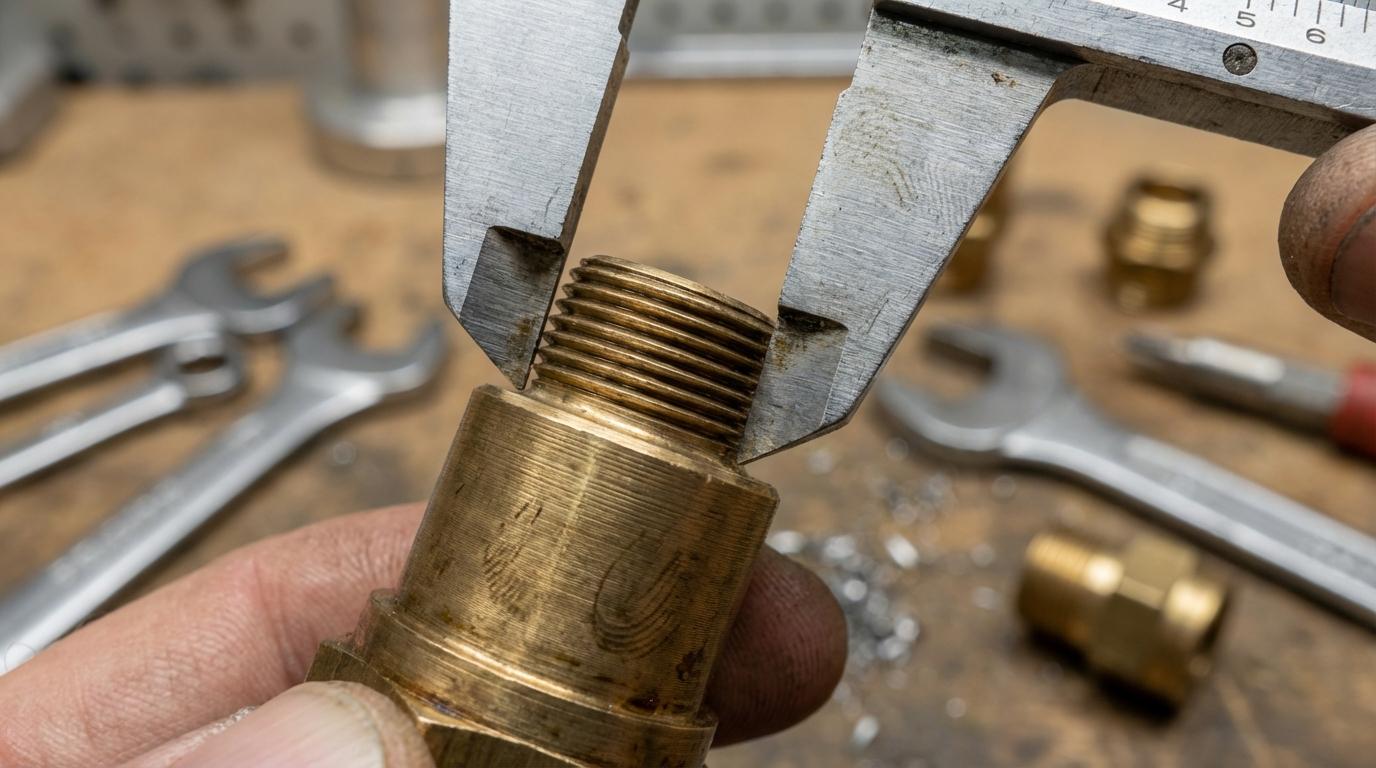
When a brass valve or fitting fails, the hardest part is often not the repair. It is figuring out what the part really is once the original brand, stamping, or part number no longer tells the full story.
A solid cross reference turns an unknown or discontinued component into a clearly specified replacement that fits, seals, and holds pressure with confidence. Industrial Parts Fittings supports that process with a broad U.S.-made catalog of brass valves, adapters, and fittings, plus fast-turn custom machining when the “closest match” is not acceptable.
What “cross reference” means in brass valves and fittings
A cross reference is not just swapping one brand number for another. It is verifying equivalency across the details that determine interchangeability: threads, end style, pressure and temperature limits, body and seal materials, length, wrench clearance, and any compliance requirements tied to the application.
In many plants, the “part number” on a maintenance ticket is a house code, not a manufacturer code. Even when a manufacturer number exists, the same family can include multiple port sizes, seat materials, and end configurations that look identical on the outside.
One good cross reference reduces risk and speeds purchasing decisions across MRO, OEM builds, and distributor replenishment.
Components commonly cross-referenced
Industrial brass parts tend to cluster into repeatable families, which makes cross-referencing efficient when the right data is available.
Brass valves often include ball valves for quarter-turn shutoff, gate valves for multi-turn isolation, and check valves for one-way flow. Threaded brass ball valves are frequently specified with WOG pressure ratings that work well for water, oil, and air service when temperature stays within the valve’s seal limits.
Brass fittings cover the everyday geometry of piping and tubing transitions: elbows, tees, couplings, unions, nipples, reducers, hose barbs, flare and inverted flare fittings, compression styles, and push-in tube fittings. Adapters that bridge standards (NPT to BSP, flare to NPT, hose thread to NPT) are especially common in replacement sourcing.
The information that makes a cross reference accurate
A clear photo and three measurements can outperform a vague part number. Even small differences, like BSPP vs NPT or a reduced-port valve vs full-port, can change performance and installation outcomes.
After you identify what you can see, the next step is capturing what you cannot see, meaning internal geometry and sealing method.
Send what you have after any paragraph or email summary, even if it feels incomplete:
- Photos: both ends, any markings, and the installed orientation if possible
- Connection details: NPT, NPTF, BSPT, BSPP, flare, compression, push-in, hose thread
- Size callouts: nominal pipe size, tube OD, and any reducer steps
- Valve specifics: full-port vs reduced-port, handle orientation limits, locking needs
- Service conditions: media, max pressure, temperature range, indoor/outdoor exposure
- Compliance needs: lead-free requirements, D.O.T. air brake approval, customer specs
Cross-reference checkpoints (what gets matched)
The fastest way to avoid returns is to treat each cross reference like a short engineering review. This table shows the fields that typically matter most and what they influence in the field.
| Cross-reference field | What to confirm | Why it matters |
|---|---|---|
| Thread standard | NPT/NPTF vs BSPT vs BSPP | Prevents leaks and cross-threading |
| Gender and end style | Male/female, swivel, union, flare seat angle | Determines whether it physically connects |
| Pressure rating | WOG rating, class rating, cracking pressure for checks | Protects safety margin and uptime |
| Temperature rating | Seat material limits (PTFE, Buna, Viton) | Prevents softening, extrusion, or hardening |
| Material and alloy | Standard brass/bronze vs lead-free alloys | Drives corrosion behavior and compliance |
| Port geometry | Full-port vs reduced-port, Cv/Kv when available | Controls flow and pressure drop |
| Envelope dimensions | Overall length, hex size, handle swing | Ensures fit in tight assemblies |
| Special approvals | NSF/ANSI 61/372, AB1953/S3874, D.O.T. air brake | Keeps the system audit-ready |
Common equivalency traps to avoid
Many “almost correct” replacements fail at install time, not because the brass is poor quality, but because a hidden detail was missed.
These are recurring issues seen across industrial maintenance and line builds:
- NPT matched to BSPT
- Male flare seat mismatch (37° vs 45°)
- Compression fittings reused with worn ferrules
- Thread sealant used where an O-ring face seal is required
- Check valve installed backwards due to mirrored body markings
A careful cross reference catches these early, before a crew is waiting on a second shipment.
Material and compliance choices that affect sourcing
Brass is a strong general-purpose material for fluid and air control, yet the right brass depends on the job. Potable water and many regulated plumbing applications require lead-free alloys that meet modern limits, often referenced through NSF/ANSI 61/372 and state rules like AB1953.
For vehicle and industrial pneumatic braking, D.O.T.-approved air brake fittings can be non-negotiable. Cross-referencing here is as much about documented approval and form factor as it is about size.
Plated finishes also matter. Chrome or nickel plating can improve corrosion resistance and appearance, but it does not automatically satisfy lead-free requirements. When compliance is part of the spec, the base alloy and certification path should be confirmed.
When a catalog match is close, but not correct
Some assemblies were designed around a legacy envelope or a special port layout, and the market standard may have shifted since then. This shows up in compact manifolds, test stands, older equipment skids, and niche OEM builds.
In those cases, custom-fabricated brass components can bridge the gap without forcing a redesign of the surrounding piping. Industrial Parts Fittings supports custom machining for precision components when a direct catalog replacement cannot meet the dimensional or functional requirements.
A single fitting that matches the original face-to-face or thread stack-up can prevent a chain reaction of rework.
A practical replacement sourcing workflow
Most replacement projects move fastest when purchasing and engineering share a single “source of truth” on the part’s critical attributes.
A typical workflow looks like this:
- Collect photos, measurements, and service conditions from the field
- Identify connection standard and end configuration first, then validate size
- Confirm rating and compliance requirements tied to the application
- Select a catalog part or propose a custom-machined equivalent
- Verify fit constraints and installation method before release to purchasing
This structure keeps decisions defensible, especially when the original component is discontinued or the original manufacturer is unknown.
Where cross referencing adds the most value
Cross-reference and replacement sourcing is useful anywhere downtime is expensive and documentation matters: OEM production lines, MRO storerooms, distributor counter sales, and regulated systems that require proof of compliance.
Industrial Parts Fittings supports procurement teams, engineers, technicians, and distributors with American-made brass valves and fittings across many categories, including flare fittings, compression styles, pipe fittings, hose barbs, lead-free components, and D.O.T.-approved air brake fittings, with responsive support when a part needs to be pinned down quickly.
Keywords:
brass fitting cross reference