NPT, BSPP, BSPT Threads Explained (With a Quick Identification Checklist)
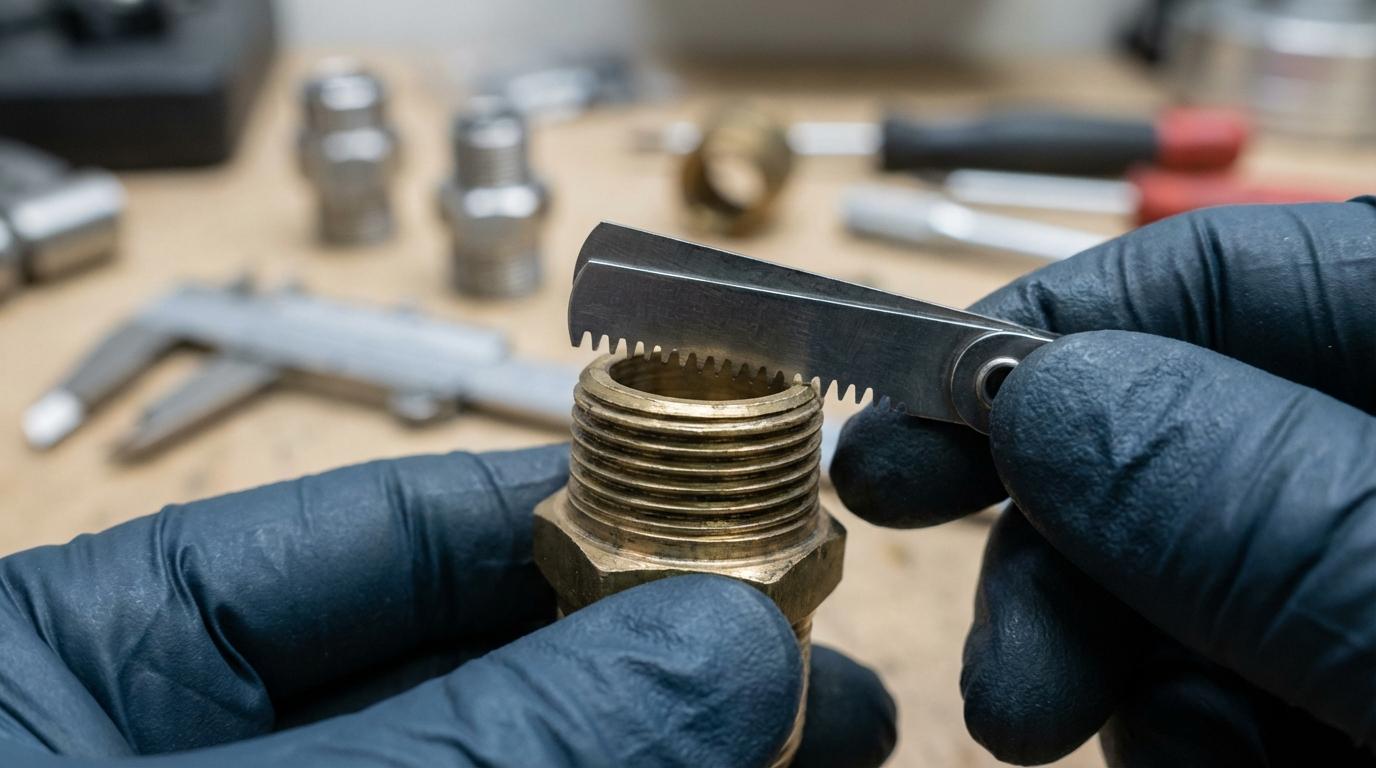
Thread mix-ups are rarely dramatic at the workbench. They become dramatic after installation, when a “tight” joint weeps, a gauge reads wrong because it is seated on damaged threads, or a maintenance team loses hours chasing a leak that was built in from the start.
NPT, BSPP, and BSPT all look like “pipe threads,” and they often appear on the same project once equipment, instruments, and replacement parts start crossing borders. The good news is that they are easy to separate once you know what to measure and where each style is supposed to seal.
The three thread types, in working terms
NPT (National Pipe Taper) is the familiar North American tapered pipe thread. It is built to tighten by wedging, and it normally relies on thread sealant to eliminate the spiral leak path that can remain between thread flanks.
BSPP (British Standard Pipe Parallel), also called a “G” thread, is a parallel pipe thread used widely outside North America, especially on instrumentation and hydraulic ports. Because it is parallel, it does not tighten into a wedge seal; it is commonly paired with a sealing washer, bonded seal, or O-ring at a face or shoulder.
BSPT (British Standard Pipe Taper), also called an “R” thread, is a tapered BSP thread. Like NPT, it tightens by interference, and it typically uses sealant. Where BSPT differs is in the Whitworth thread form geometry, which makes it incompatible with NPT even when the nominal size sounds similar.
Geometry that decides compatibility (and why “close enough” is not)
A thread standard is not just diameter and pitch. The included angle and the crest and root shape are part of the sealing system and the strength of the engaged joint.
NPT uses a 60° thread angle with flat crests and roots (Sellers form). BSP threads use a 55° Whitworth profile with rounded crests and roots. That 5° difference sounds small until you realize it changes how the load is carried across the flanks. When people force an NPT male into a BSP female (or the reverse), the parts can bite for a few turns, then bind, gall, or crack the female port.
Taper is the next big divider. NPT and BSPT are tapered at 1:16. BSPP is parallel. A parallel female port is not intended to seal on the threads, and a tapered male is not intended to “bottom out” against a flat face.
Pitch is the quiet detail that catches experienced technicians off guard. Many trade sizes are close but not the same, and a mismatch can still “start” by hand, which is exactly what makes it risky.
Fast comparison table
| Feature | NPT (ASME B1.20.1) | BSPP “G” (ISO 228-1) | BSPT “R” (ISO 7-1) |
|---|---|---|---|
| Thread form angle | 60° | 55° | 55° |
| Crest/root shape | Flat | Rounded | Rounded |
| Taper | Tapered (1:16) | Parallel | Tapered (1:16) |
| Typical seal | Thread interference plus sealant | Face seal with washer or O-ring | Thread interference plus sealant |
| Common marking style | “NPT” | “G” or “BSPP” | “R”, “Rc”, “BSPT” |
Sealing behavior: wedge seal vs face seal
Thread geometry matters because it dictates where the seal is supposed to happen.
With NPT and BSPT, the taper creates a wedging action. As the male advances, the flanks press together and friction rises quickly. In practice, sealant is used for two reasons: it fills the microscopic voids between surfaces and it lubricates the assembly so the joint can reach its intended engagement without tearing the thread.
With BSPP, tightening the threads mainly positions the fitting. The seal is made at a separate interface, typically:
- a bonded seal under a male fitting’s shoulder,
- a copper crush washer against a flat face,
- an O-ring captured in a chamfer or undercut, depending on the port design.
This is why “adding more tape” does not fix a leaking BSPP joint if the washer is missing, hardened, or seated against the wrong face. The threads were never the sealing surface.
A single sentence worth remembering: a BSPP thread can be perfect and still leak if the correct face seal is not present.
A quick identification checklist you can trust
Start by assuming nothing. Equipment may have been repaired before, ports can be re-tapped, and adapters can hide on the back side of a manifold.
Use this checklist in order, because it moves from fastest to most decisive tests.
- Taper check: Measure the OD at the first full thread and again near the end; a noticeable change points to NPT or BSPT, while a constant OD points to BSPP.
- Thread angle cue: A 60° thread looks sharper and more “V-shaped,” while a 55° Whitworth form looks slightly softer with rounder crests.
- Pitch confirmation: Use a pitch gauge; common tell is 1/4 in NPT at 18 TPI versus 1/4 in BSP at 19 TPI.
- Sealing surface hunt: Look for a captive O-ring, bonded seal, or washer seat; that hardware is a strong sign of BSPP.
- Markings: “NPT” is common on North American components; “G” often points to BSPP; “R/Rc” often points to BSPT.
- Hand engagement feel: Tapered threads tighten progressively after a few turns; parallel threads stay consistent until the washer or shoulder contacts.
- Gauge when it matters: Go and No-Go gauges (ASME or ISO) remove doubt when safety, compliance, or high pressure is in play.
What goes wrong when threads are mixed
Most failures are not immediate. The connection often assembles just enough to look acceptable, then fails under vibration, thermal cycling, or pressure spikes.
A few patterns show up again and again:
- Cross-threaded starts that “clean up” the female port on the way in
- Split brass ports on castings that were never meant to wedge that hard
- Chronic weeping that returns after every restart
- Fittings that back out because the thread flank contact is partial
The most productive mindset is simple: if the seal strategy is wrong, the joint is wrong, even if it holds today.
NPT vs BSPT: the confusing cousin problem
NPT and BSPT share a taper rate, which tempts people to treat them as interchangeable. They are not.
The mismatch comes from the combination of angle, crest shape, and pitch series. A tapered joint depends on full flank contact to share load across multiple threads. When only partial contact occurs, localized stress rises, and the joint becomes both harder to seal and easier to damage.
If you are faced with an NPT component that must connect to a BSPT port (or the reverse), the correct move is a purpose-made adapter with the right standard on each side, not a “make it fit” attempt.
Choosing the right thread for the job (and writing it down clearly)
Selection is less about regional habits and more about the mechanical and service needs of the connection.
NPT remains common in North American plumbing, general industrial piping, and many U.S.-built pneumatic assemblies. BSPP is popular on hydraulics and instrumentation because a designed face seal is repeatable, service-friendly, and less sensitive to the “how tight is tight” problem that plagues taper threads. BSPT remains common in global plumbing and gas service where taper-thread practice and tooling are already established.
Where procurement and engineering teams win is in the callout detail. If a drawing or PO only says “1/2 pipe,” it invites rework.
After a paragraph like that, the practical checklist is short and worth standardizing:
- Define the standard: NPT, BSPP (G), or BSPT (R).
- Define the seal method: thread sealant for taper threads, washer or O-ring for BSPP.
- Define the interface: male, female, swivel, port type, and any required seat geometry.
- Define material and compliance needs: lead-free brass requirements (when applicable), corrosion needs, approvals tied to the application.
- Define inspection expectations: gauges, thread class, and acceptance criteria when parts are safety-critical.
For teams that source both catalog and custom parts, this is also where a responsive manufacturer or distributor adds value: asking the one clarifying question that prevents a box of beautifully made, perfectly wrong fittings from landing on the dock.
Industrial Parts Fittings, for example, supports both standard catalog brass fittings and custom-fabricated adapters, which matters when a plant has to bridge thread standards without changing legacy equipment. Fast turnaround is only helpful when the specification is unambiguous.
A note on sealants, washers, and torque habits
Sealant is not a universal fix. It is a component of a tapered thread system, not a substitute for the right thread.
For NPT and BSPT, consistent results come from clean threads, the right sealant for the media and temperature, and controlled engagement. Over-tightening can crack ports, especially in softer materials, while under-tightening leaves an incomplete wedge and a leak path.
For BSPP, the washer or bonded seal is the star of the show. A fresh seal in the right material beats extra wrench force every time. If a BSPP joint is leaking, inspect the sealing face for nicks, check for the correct washer type, and confirm the shoulder actually contacts the intended seat.
Stocking and kitting: preventing downtime when equipment is global
Sites that run mixed-origin equipment tend to become their own small “thread ecosystem.” The goal is not to carry everything; it is to carry the right bridges and verification tools.
A practical spares strategy usually includes:
- one pitch gauge set that covers the common pipe TPI and metric pitches,
- calipers,
- a small, labeled set of common NPT to BSPP and NPT to BSPT adapters,
- the correct bonded seals and washers for BSPP ports in the sizes actually on the floor.
Labeling helps more than most people expect. Tagging ports on skids and manifolds with “NPT” or “G” pays back the first time a night shift repair avoids a thread mismatch.
When a connection is built with the right standard, the right seal strategy, and a clear spec, it stops being a recurring problem and becomes what it should have been all along: a dependable, maintainable interface that frees the team to focus on the system, not the leak.
Keywords:
npt vs bspp vs bspt