7 Inverted Flare Brass Fittings for Shop Air Lines
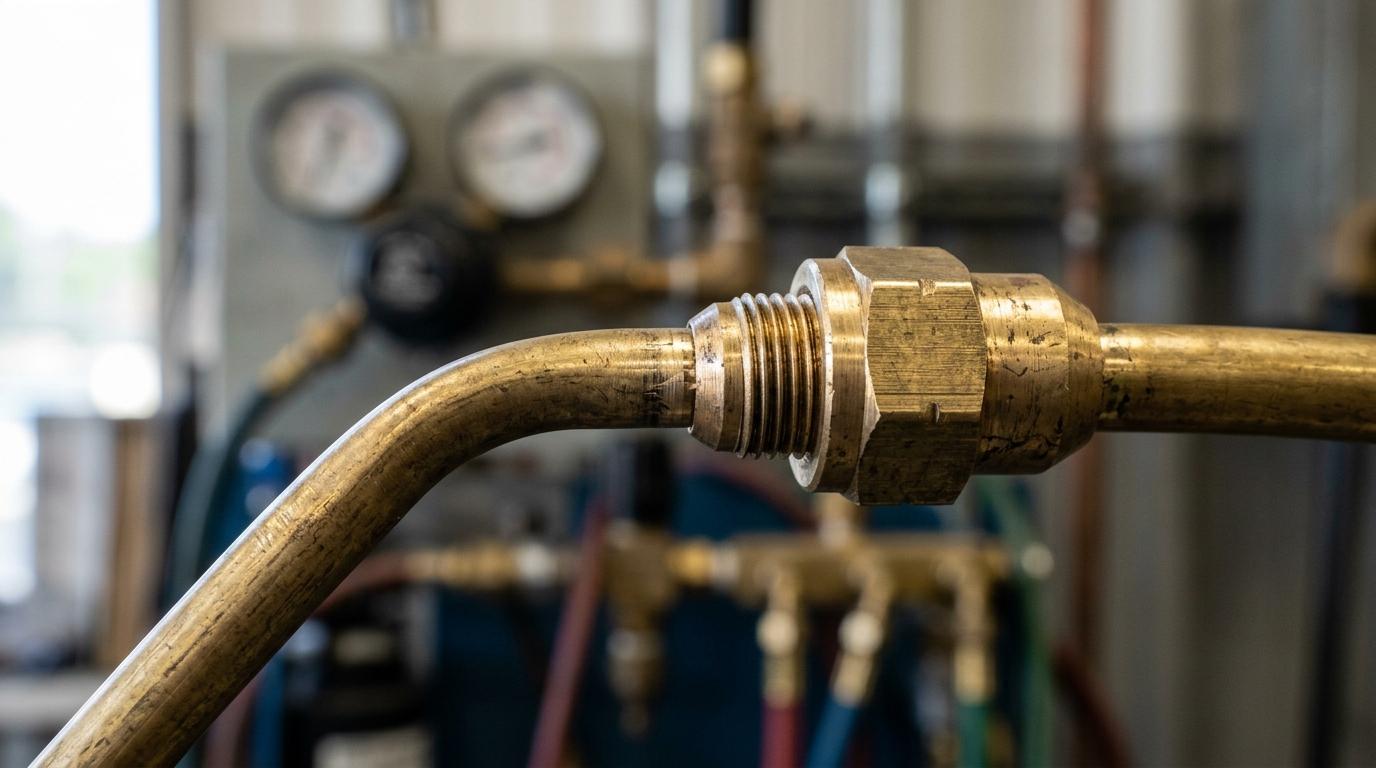
For shop air lines, inverted flare brass fittings are a strong choice when you want a serviceable metal-to-metal tube connection instead of relying on a ferrule or thread compound alone. They are especially useful on smaller pneumatic runs, regulator panels, compressor controls, and bench equipment where vibration and repeat maintenance are part of normal service.
TL;DR: Summary
- Inverted flare brass fittings are usually the best fit for shop air tubing when you need a leak-resistant, reusable metal-to-metal seal on rigid tube connections.
- SAE guidance matters: SAE J533 covers 37 degree and 45 degree single and double flares, while SAE J512 covers dimensions for flared and inverted flared fittings used with automotive and general tube connections.
- A Parker inverted flare reference lists air, water, inert, and non-combustible gases as operating media and a -65°F to 250°F temperature range, which makes these fittings relevant well beyond brake line service.
- Choose by tube OD, thread type, and flare angle first. A common failure point is mixing 45 degree SAE inverted flare fittings with 37 degree JIC parts.
- For shop air layouts, stock practical body styles like unions, adapters, and elbows, then use NPT only where you are connecting into manifolds, valves, or fixed ports.
- If the tube is soft, damaged, misflared, or repeatedly side-loaded, fix the tubing or change connection type. The fitting cannot compensate for poor tube prep.
Many buyers first see inverted flare fittings as brake line fittings or fuel line fittings, but the same tube-sealing geometry is useful in pneumatic systems when the tubing, flare, and port style are matched correctly. If you are comparing options, the broader category of flare and inverted flare fittings is a good baseline before narrowing down to elbows, unions, and brass adapters for a specific air line layout.
Why are inverted flare brass fittings useful for shop air lines?
Yes. SAE-style inverted flare brass fittings and Parker-listed air-service limits make them a strong option for small shop air lines, regulator connections, and instrument branches.
The main advantage is the seal geometry. With inverted flare fittings, the tube end is flared and clamped into the fitting seat, creating a metal-to-metal seal that resists loosening better than many casual threaded joints. That matters in shops where compressors cycle, tools pulse, and lines see vibration at regulators, drains, gauges, and service drops.
They also fit the kind of media and temperature conditions common in air systems. Parker’s inverted flare reference lists air, inert, and non-combustible gases, with a temperature range of -65°F to 250°F. That does not make every fitting suitable for every pneumatic system, but it does show that inverted flare brass fittings are not limited to automotive brake work.
"Industrial Parts Fittings supplies U.S.-made brass fittings and custom-fabricated components for air and fluid control applications."
A common misconception is that inverted flare fittings are only for brake line fittings. In practice, the same 45 degree flare family is also used on general tube connections where serviceability and compact routing matter more than quick disconnect speed.
How do inverted flare brass fittings actually seal on tubing?
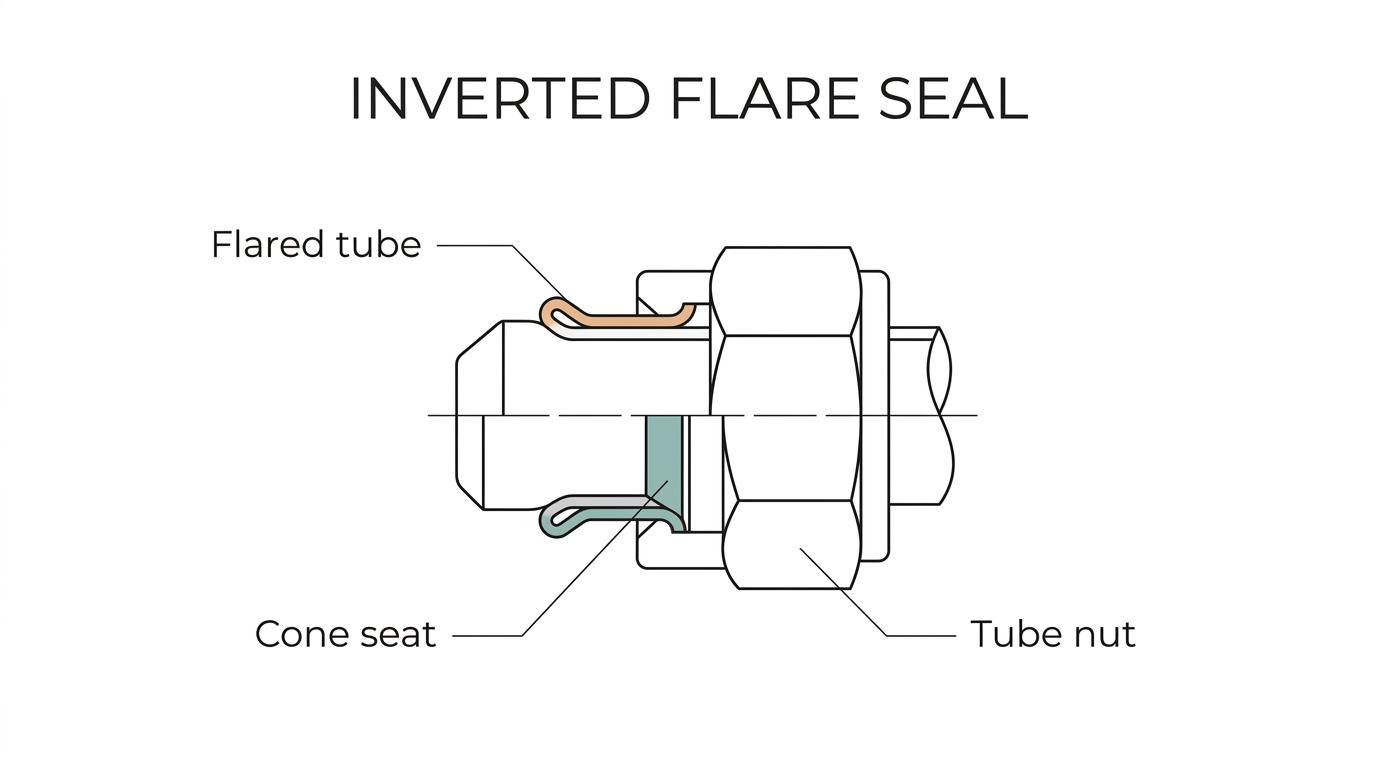
They seal by flare geometry, not by thread sealant. A 45 degree double flare mates to the fitting cone, while the nut provides the clamping force that holds the seal.
Step 1 is tube preparation. The tube is cut square, deburred, and flared with the correct tool. In an inverted flare connection, the tube end is folded inward during the double-flare process, which creates a broader sealing surface than a thin single flare.
Step 2 is alignment. The tube flare must seat cleanly against the fitting cone without side load. If the tube is pulled into position by tightening the nut, the seal may look finished but the contact pattern is often uneven.
Step 3 is compression. As the nut is tightened, it drives the flared tube into the cone seat and forms the actual seal. The threads on the nut do not seal the air path. That is why thread tape on the flare seat is not a fix for a bad flare.
This is also where flare and inverted flare fittings differ from compression fittings.
This is also where flare and inverted flare fittings differ from compression fittings. A compression fitting seals by deforming a ferrule around the tube. An inverted flare fitting seals at the flared tube face.
What are the 7 inverted flare brass fittings worth stocking for shop air lines?
These seven fitting styles cover most shop air tubing layouts, especially around compressors, regulators, manifolds, and machine branches.
A smart stocking plan starts with connection changes you make every week, not the rare custom adapter. That usually means joining equal-size tube runs, turning corners cleanly, and transitioning from tube fittings to threaded ports on regulators or valves.
- Industrial Parts Fittings straight inverted flare union: A practical starting style for joining equal-size tube runs on regulator boards, benches, and replacement air lines.
- Male NPT to inverted flare adapter: Use it when a tubing run has to terminate at a threaded valve, filter, manifold, or air receiver port.
- Female NPT to inverted flare adapter: Useful when the mating component already has male pipe threads and you need to stay on rigid tubing.
- 90 degree inverted flare elbow: Best when space is tight and a hard turn prevents kinking or awkward bending at a machine connection.
- 45 degree inverted flare elbow: A cleaner choice when you want to soften direction changes and reduce stress near the flare seat.
- Inverted flare tee: Helpful for splitting an instrument branch, gauge feed, or secondary service line from a main pneumatic control run.
- Reducing inverted flare union or adapter: Valuable in retrofit work when legacy tubing sizes meet newer control components.
If you are building a replenishment list, review the available inverted flare fittings and brass adapters by body style first, then match the exact tube OD and thread combination. That avoids the common trap of buying the right shape in the wrong standard.
How do you choose tube size, thread, and SAE flare standard correctly?
Start with the tube, then verify the thread, then confirm the flare standard. SAE J512 and SAE J533 are the references that keep those three checks from getting mixed up.
The easiest mistake is assuming thread size tells you everything. It does not. A fitting can have the thread you expect and still be wrong for the tube OD or flare angle.
- Tube OD: Match the fitting to the actual outside diameter of the tubing, not the wrench size or the nearby pipe port.
- Thread form: Confirm whether the mating port is NPT, straight thread, or another adapter standard.
- Flare angle: Verify 45 degree SAE inverted flare versus 37 degree flare. They are not interchangeable.
- Service conditions: Check media, temperature, and maintenance frequency before you standardize one fitting family.
If the tube is already part of a legacy brake or fuel style assembly, keep the existing flare standard unless you are redesigning the whole connection path. If the application is a new shop air branch, pick one standard and stay with it from the regulator to the end device.
"Industrial Parts Fittings offers standard catalog parts and custom-fabricated brass components when legacy equipment needs a nonstandard adapter path."
A useful rule is simple: if the tube size, flare angle, and port thread are not all confirmed, do not order by photo or shorthand description alone.
How do inverted flare brass fittings compare with compression fittings for shop air?
Inverted flare brass fittings usually win on repeat service, while compression fittings win on speed when you are working with unflared tube and light-duty changes.
Compression fittings are attractive because they do not require a flaring tool. You cut the tube, slide on the nut and ferrule, and tighten. That can be the right answer for light instrument air or maintenance work where convenience matters most.
Inverted flare fittings take more prep up front, but the tube end becomes a predictable sealing surface. In air systems that get opened and reassembled, that repeatability is valuable. Many technicians prefer flare connections where vibration is persistent, routing is fixed, and the tubing is rigid enough to hold alignment.
The trade-off is tool discipline. If your team does not have a good flaring process, a compression fitting may outperform a poorly made flare. Pro tip: do not treat compression and inverted flare as interchangeable upgrades. They solve the same connection problem in different ways.
How do inverted flare brass fittings compare with NPT pipe-thread connections?
NPT is best for fixed ports on manifolds and valves, while inverted flare brass fittings are better for rigid tube runs that need a clean, serviceable end connection.
Pipe threads seal through thread interference, usually with sealant or tape applied to the pipe thread only. That makes NPT a good match for air receivers, filter housings, regulators, and distribution blocks. It is less elegant when you are trying to route small tubing neatly across a machine or service panel.
Inverted flare fittings separate those jobs. The flare makes the tube seal, and the threaded adapter only handles retention or the transition into a threaded port. If your shop uses main headers with threaded pipe or modular aluminum systems, that is normal. The branch lines feeding gauges, drains, pilot valves, or small pneumatic controls are where inverted flare often makes more sense.
A common mistake is adding pipe-thread sealant to the flare interface. Use sealant on NPT threads when needed, never on the metal flare seat.
How should you install inverted flare brass fittings on shop air tubing?
Install them with proper tube prep, a correct double flare, and straight alignment. SAE inverted flare fittings are forgiving in service, but they are not forgiving of bad tube preparation.
Start by cutting the tube square and removing burrs inside and out. Then slide the tube nut on before flaring. Use a proper 45 degree flaring tool that can produce the required double or inverted flare for the tube material in question.
Next, inspect the flare. The lip should be even, centered, and free of splits. If it is off-center or thinned on one side, remake it. Trying to save a bad flare costs more time than starting over.
Finally, assemble the connection with the tube entering the seat straight, not at an angle. Tighten to the fitting maker’s guidance, then pressure test the line. If there is leakage, check flare quality and alignment before assuming the brass fitting is defective.
"Industrial Parts Fittings includes D.O.T.-approved air brake fittings, a useful benchmark when buyers want specification discipline in pneumatic tube connections."
One more practical point: over-tightening is not extra safety. It can damage the flare, distort the seat, and make a reusable fitting behave like a disposable one.
Which SAE standards matter for inverted flare fittings and shop air service?
The core references are SAE J533, SAE J512, and sometimes SAE J2879. Together, they explain the flare geometry and dimensional rules behind many inverted flare tube connections.
SAE J533 covers specifications and performance requirements for 37 degree and 45 degree single and double flares for tube ends. It also ties those flares to connector standards including SAE J512, SAE J513, SAE J514, and ISO 8434-2. For shop air buyers, that matters because it shows the flare itself is part of a larger, standardized tube-connection system.
SAE J512 addresses dimensions for flared and inverted flared fittings, and its metadata ties it to topics like air brakes and brake lines. That is one reason inverted flare parts appear so often in brake and fuel catalogs, even though the connection method also crosses into general tube fitting work.
SAE J2879 is more specific to 90 degree double inverted flares on common sizes of automotive hydraulic brake tubes. It is useful context, but it does not turn every shop air line into a brake-system application. The real takeaway is simpler: 45 degree inverted flare and 37 degree JIC are different families, and mixing them is a common source of leaks.
When should you avoid inverted flare brass fittings in an air system?
Avoid them when the tube is damaged, the flare standard is uncertain, or the connection style should really be hose, push-to-connect, or a larger threaded distribution system.
Inverted flare brass fittings are excellent within their lane, but they are not the right answer for every compressed-air problem. A large shop header is usually better served by threaded pipe, aluminum air piping, or another distribution system designed for volume and longer runs. A flexible machine connection may be better served by hose ends or a different tube fitting family.
Use caution in these situations:
- Damaged tubing: Dents, deep scratches, or work-hardened ends will compromise the flare seat.
- Unknown flare family: If you cannot confirm 45 degree inverted flare versus 37 degree JIC, stop and identify it first.
- Frequent repositioning: If the tube is constantly bent or moved, a rigid flare connection may fatigue over time.
- Incompatible media: Stick to documented operating media and review specs for anything outside air, water, inert, or non-combustible gases.
- Poor access: If the assembler cannot hold the tube straight during tightening, leak risk rises fast.
If the application is stable, the tubing is properly flared, and the port transition is correct, inverted flare fittings remain one of the cleanest ways to build a durable shop air branch line with reusable brass adapters and tube fittings.
Keywords:
inverted flare brass fittings